
Stepping into your first semester of BICTE and facing college programming exams for the very first time can feel intimidating, especially when writing code by hand on paper. Working through real board exam questions helps you understand how Tribhuvan University evaluates theory, syntax, and algorithmic logic.
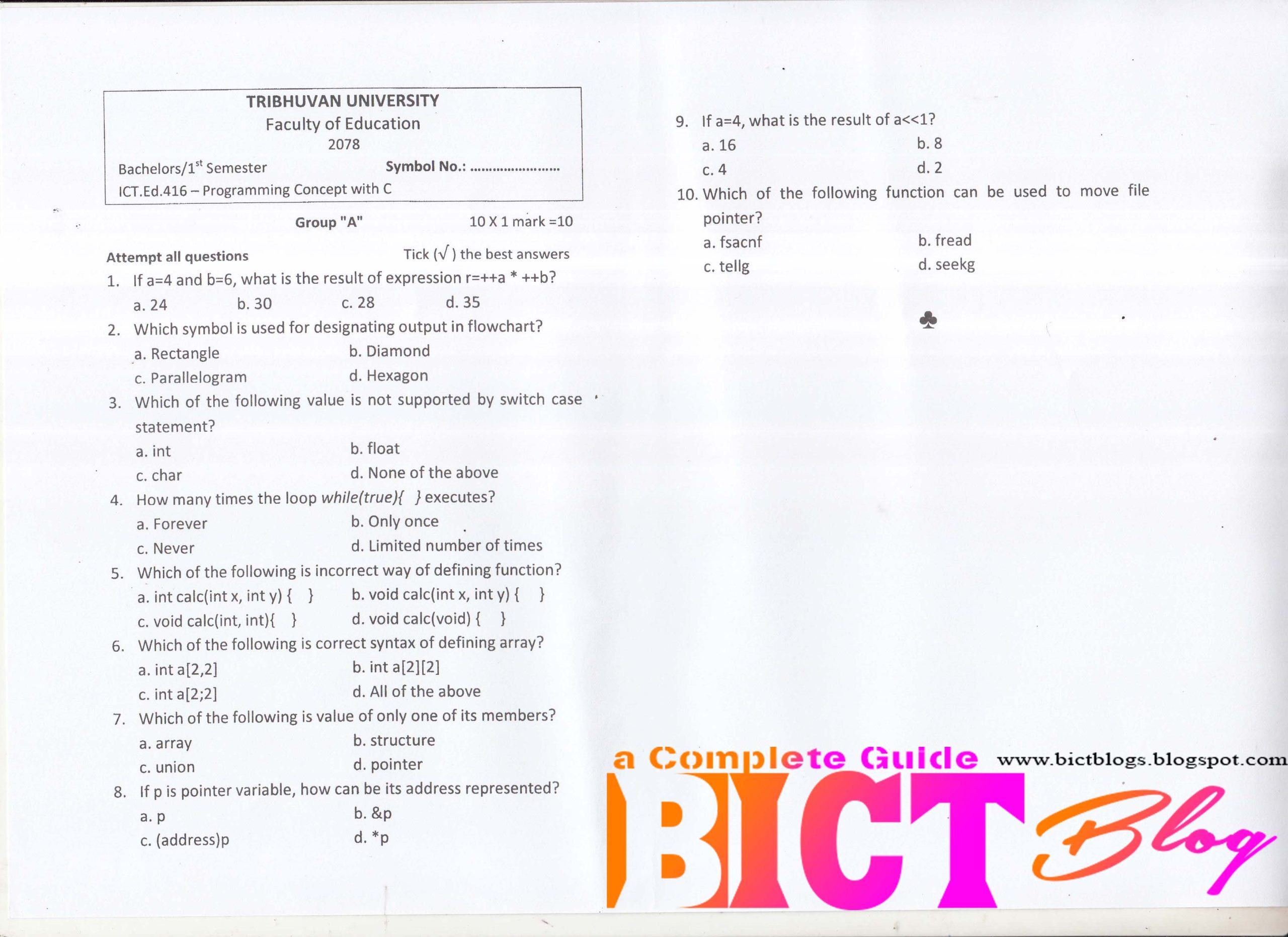
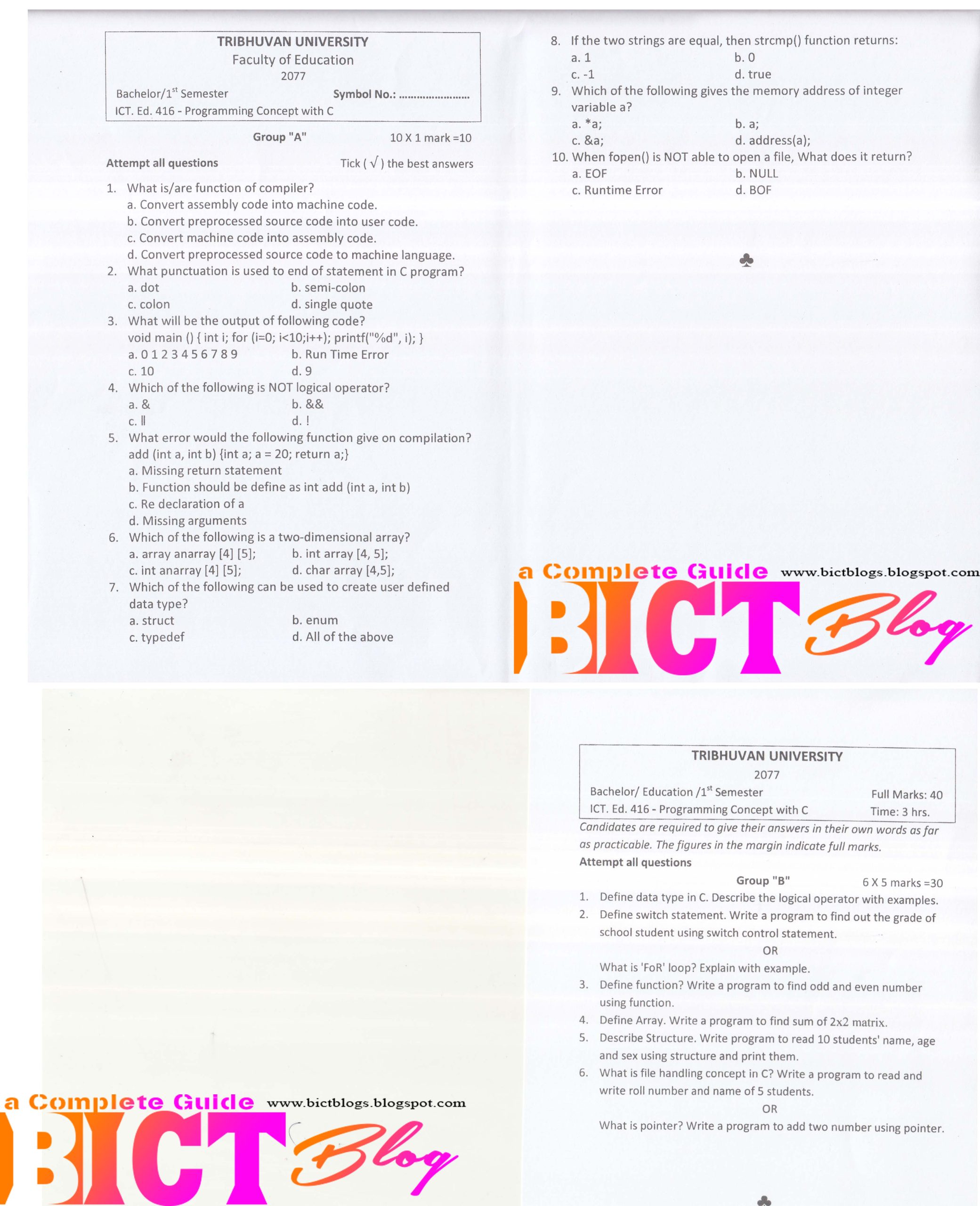
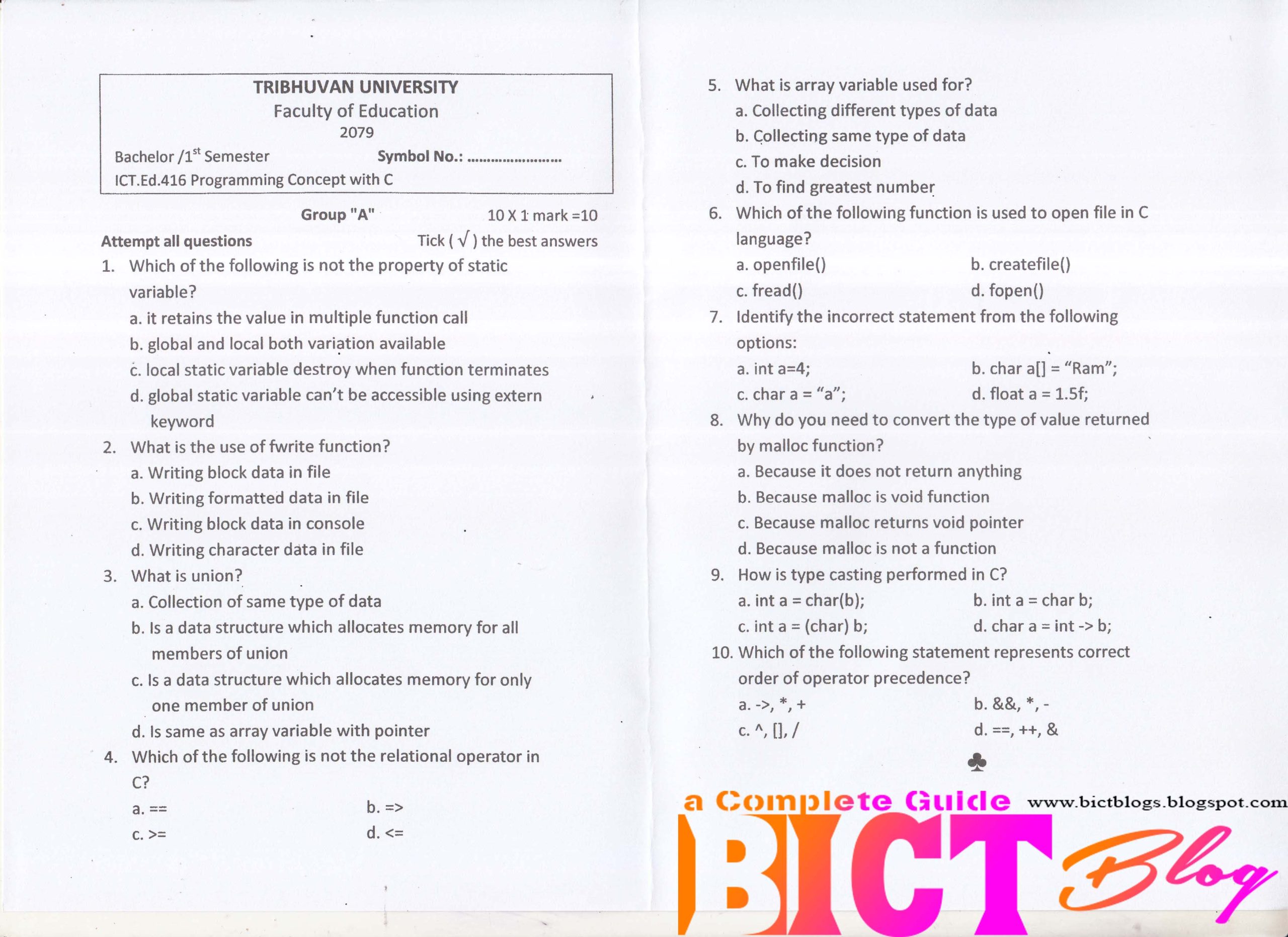
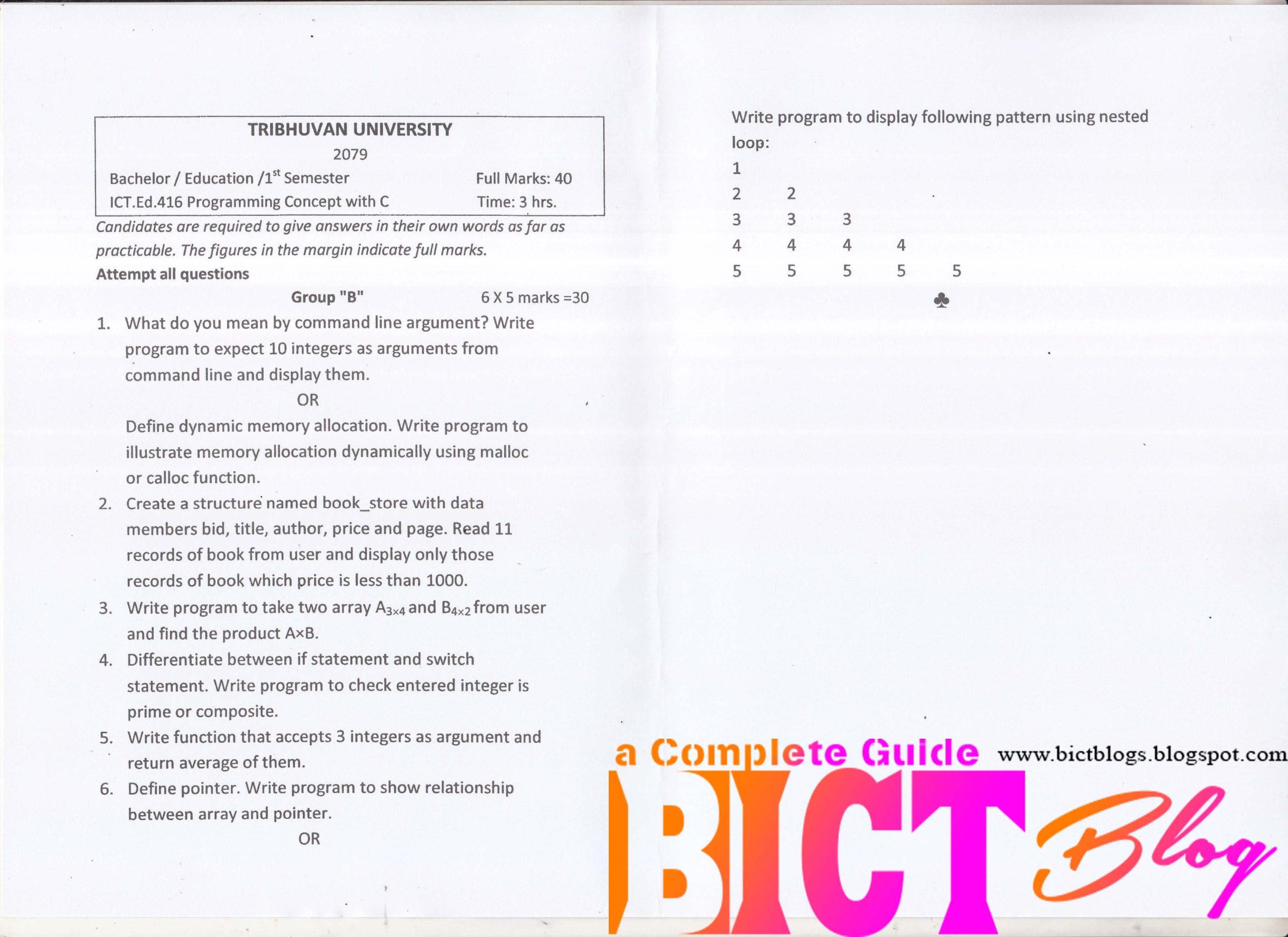
This resource brings together the official TU Faculty of Education question papers for BICTE 1st semester Programming Concept with C (course code ICT.Ed.416) from 2076 BS through 2080 BS. It covers both the objective multiple-choice question sheets and the analytical problem sets from successive board exams.
Whether you are revising core looping structures or checking how TU tests advanced topics like structures, file handling, and pointers, practicing with these authentic papers will build your problem-solving speed and exam confidence.
TU BICTE 1st Semester C Programming Question Papers 2076–2080




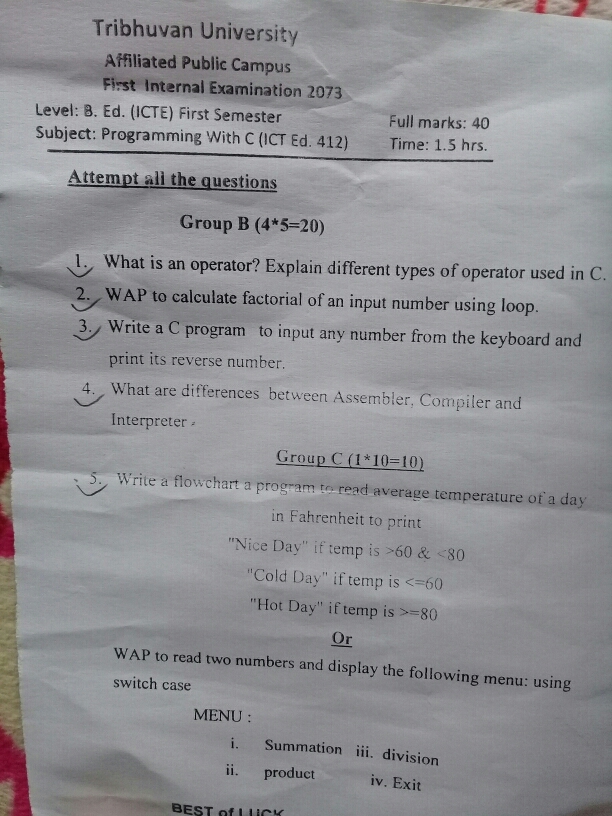


What the C Programming Board Examination Covers
Examinations for Programming Concept with C test both foundational computing theory and hands-on coding proficiency. The objective sections emphasize precise language mechanics, including operator precedence, bitwise and unary operators, format specifiers, identifier naming conventions, and the distinction between variable declaration and definition. These prompts require a sharp eye for syntax details and compilation rules that often challenge students during timed tests.
In the descriptive sections, questions center on problem-solving logic through flowcharting, algorithm development, and structured programming. You are routinely expected to write working C programs involving decision-making constructs, looping mechanisms, user-defined functions with parameter passing, and array manipulations such as matrix calculations. Demonstrating clear program flow and logical structure is essential for securing strong marks in these problem sets.
A substantial portion of the exam questions explores composite data structures, memory management, and file storage. TU consistently assesses your ability to declare and utilize structures, manage arrays of structures, distinguish between structures and unions, and perform file handling operations using standard library stream functions. Mastering both the theoretical definitions and practical implementations of these concepts ensures thorough preparation for the syllabus.
Exam Preparation Tips for BICTE C Programming
Always write out complete C programs by hand in a notebook rather than only testing them in an IDE. In paper-based university examinations, you will not have compiler error messages to catch forgotten semicolons, missing ampersands in input statements, or unmatched braces. Building muscle memory for handwritten syntax prevents simple errors from costing you valuable marks.
Pay close attention to pointer arithmetic and dynamic memory allocation concepts. Questions frequently ask you to explain how pointers interface with arrays and strings, or how to allocate memory blocks dynamically. Drawing clean memory diagrams showing variable addresses, pointer references, and heap allocations alongside your written answers demonstrates a clear understanding of low-level memory behavior to examiners.
Practice standard algorithms for core programming tasks such as prime number verification, factorial generation, matrix multiplication, and string manipulation. TU exam questions frequently require you to implement logic from scratch without relying solely on built-in functions. Sketching a clear flowchart before writing your code clarifies your thought process and saves time during the test.
When preparing file input and output, ensure you understand file opening modes, error handling for missing files, and the difference between formatted, character, and block read-write operations. Practice writing concise, self-contained routines that open a file, write or read structured records, and safely close file streams. Clean file operations reflect strong coding discipline.
Frequently asked questions
What is the format of the TU BICTE C programming board exam?
The Tribhuvan University BICTE 1st semester exam for Programming Concept with C includes Group A with objective multiple-choice questions on syntax, operators, and language rules, and Group B with descriptive questions requiring theoretical explanations, algorithms, and complete C programs.
Which topics appear most frequently in BICTE C programming questions?
Board exams regularly focus on control flow statements, functions, arrays and strings, structures and unions, pointer fundamentals, and file input-output operations. Writing complete programs for prime numbers, matrix operations, or student file records appears consistently across exam years.
Are flowcharts and algorithms required in the examination?
Yes, several descriptive questions specifically instruct students to provide an algorithm and draw a flowchart before or alongside the C code. Practicing standard flowchart symbols and step-by-step logic helps you score full marks on program design questions.
How should I prepare for the objective MCQ section?
Review operator precedence tables, escape characters, bitwise shifts, type casting syntax, and standard header file declarations. Practicing past objective sheets helps you spot tricky questions involving prefix and postfix operators, pointer declarations, and loop conditions.
About Noted Insights
Noted Insights was founded by Ajay Mahato in 2022 to provide university students and tech learners across Nepal with dependable study materials, college notes, past question papers, and syllabi. Guided by the belief that quality education transforms lives, the platform works to make premium academic resources accessible to everyone regardless of location.
Our vision is to build an active learning community where future educators and IT professionals can connect with peers and mentors, master essential computer science subjects, and achieve their academic goals. Work through these past C programming papers methodically, stay consistent with your coding practice, and approach your 1st semester board exams with total confidence!