
Stepping into the third semester of your bachelor’s degree often brings a sudden leap in technical rigor, and mastering hardware concepts can feel overwhelming without seeing how theories get tested. Reviewing actual board exam papers remains the single most reliable way to understand how evaluators frame their questions and where to concentrate your revision hours.
This collection brings together the Tribhuvan University past question papers for Bachelor in Information Communication Technology Education (BICTE) 3rd semester in Computer Architecture and Organization (course code ICT.Ed.439). The archive features board exam papers from the 2079 and 2080 Bikram Sambat sessions under the updated curriculum administered by the Faculty of Education.
Working through these papers helps you familiarize yourself with both multiple-choice questions and detailed theoretical problems. Whether you are revising register transfer operations, instruction formats, or memory hierarchies, reviewing past examinations ensures that your preparation aligns directly with university standards.
BICTE 3rd Semester Computer Architecture Question Papers 2079–2080
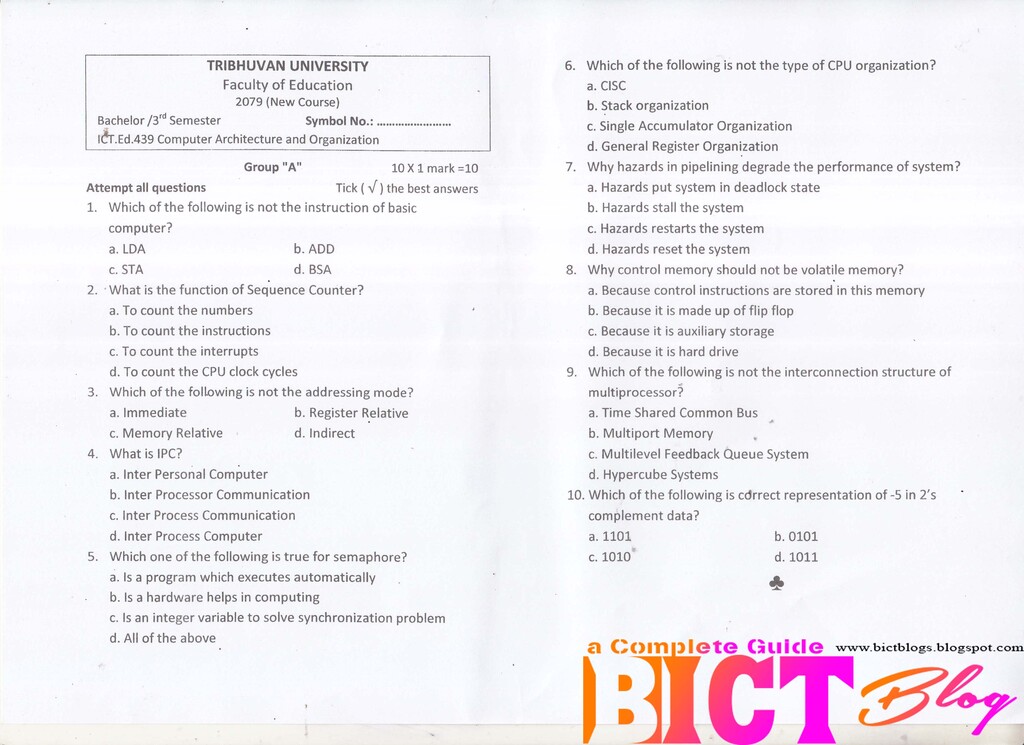

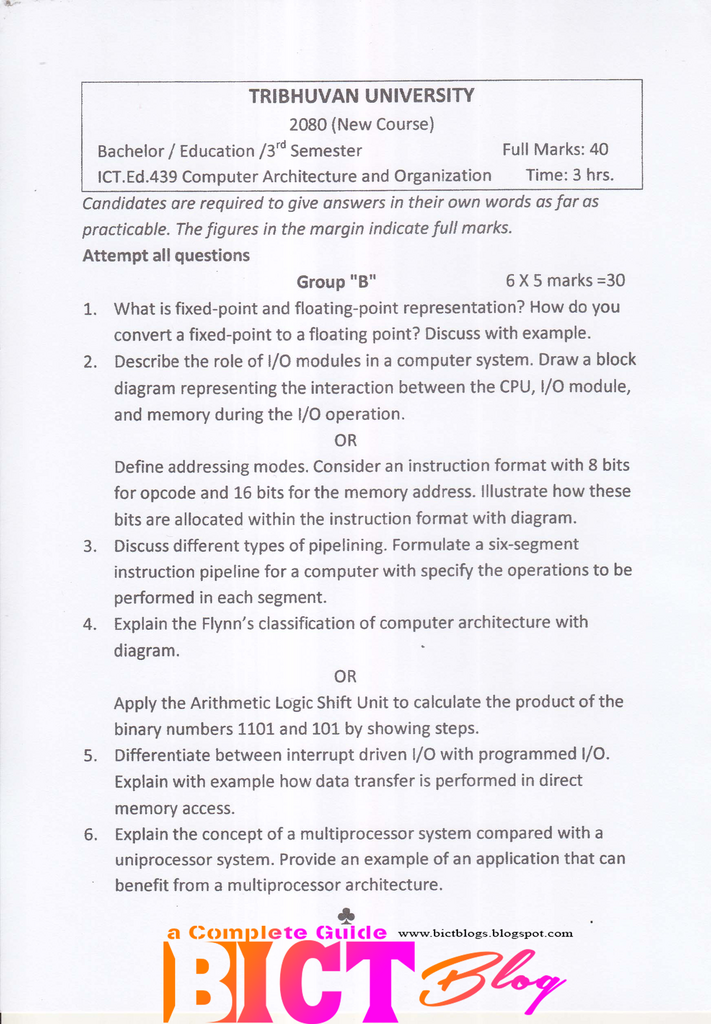
Overview of Computer Architecture and Organization Exam Topics
Computer Architecture and Organization examines the foundational structures that make computation possible, bridging low-level hardware components with machine execution. The board questions focus extensively on the central processing unit, exploring register transfer logic, basic computer instruction sets, microoperations, and how control units orchestrate machine cycles through microprogrammed or hardwired sequences.
Arithmetic representation and execution logic form another core focus of the examination. Questions frequently test fixed-point and floating-point numeric systems, complement arithmetic, and the internal design of arithmetic logic shift units. Understanding how basic binary operations carry through processor stages is essential for answering analytical questions accurately.
Input-output organization and memory management are regularly assessed to ensure students understand system-level data movement. Topics span programmed input-output, interrupt-driven transfers, and direct memory access mechanisms, alongside cache hierarchies and control memory characteristics. Being able to compare communication models and explain interaction diagrams helps secure marks in these descriptive sections.
Modern architecture themes also appear consistently, reflecting advancements in processor efficiency and throughput. The papers address instruction pipelining, pipeline hazard management, Flynn’s classification of computer architectures, and the principles governing multiprocessor coordination. Mastering these concepts provides a well-rounded foundation for both theoretical evaluation and practical computing knowledge.
Preparation Tips for BICTE Computer Architecture and Organization
When preparing for Computer Architecture and Organization, make architectural diagrams second nature. Evaluators look for clean block diagrams when asking about central processing unit interactions, input-output module interfacing, and bus structures. Label every data line, control signal, and register clearly to demonstrate a precise conceptual understanding.
Pay close attention to binary calculations and data representation algorithms. Practice step-by-step arithmetic operations, such as two’s complement arithmetic and arithmetic logic shift unit calculations, so you do not lose easy marks on calculation errors during timed exams. Showing intermediate steps clearly communicates your problem-solving process to the examiner.
Dedicate sufficient study time to instruction formats, addressing modes, and pipelining stages. When tackling pipelining questions, practice sketching out pipeline segment diagrams and explaining how hazards stall execution. Similarly, ensure you can break down opcode and operand bit allocations for varied memory addressing configurations.
Finally, allocate time for objective multiple-choice practice alongside long descriptive questions. Objective items test specific definitions, flag conditions, and component roles, requiring accurate recall under pressure. Simulating full examination conditions with past papers will help you balance time effectively across short objective checks and detailed theoretical answers.
Frequently asked questions
What is the exam structure for BICTE 3rd Semester Computer Architecture and Organization?
The examination conducted by Tribhuvan University Faculty of Education includes an objective section (Group A) featuring multiple-choice questions worth 10 marks and a descriptive section (Group B) containing analytical and problem-solving questions worth 30 marks, totaling 40 full marks for the written board exam.
Which topics are most frequently asked in the ICT.Ed.439 board exam?
Commonly evaluated areas include register transfer operations, instruction formats and addressing modes, direct memory access (DMA), input-output module interaction, instruction pipelining and hazards, fixed-point and floating-point representations, and multiprocessor architectures.
How can I best use these old questions for exam preparation?
Begin by revising each topic from your course textbook and lecture notes, then solve past questions without referring to solutions. Practice drawing system diagrams and writing out binary arithmetic steps within standard exam time limits to build speed and confidence.
Where can I find the official syllabus and materials for other BICTE semesters?
Noted Insights hosts syllabus documents, model questions, and past examination papers across all semesters of the BICTE curriculum under Tribhuvan University, easily accessible through the site navigation categories.
About Noted Insights
Noted Insights was founded in 2022 by Ajay Mahato to ensure that college notes, syllabi, past questions, and technical references remain freely accessible to every university student. Grounded in the conviction that quality education transforms lives, the platform strives to eliminate educational barriers for learners across Nepal, regardless of background or geographic location.
Our mission is to equip future educators and IT professionals with the resources they need to thrive in technical disciplines like computer architecture and system design. We are building a dynamic learning community where students can engage with mentors, expand their problem-solving skills, and pursue academic excellence. Best of luck with your BICTE board examinations—stay persistent, believe in your preparation, and achieve your goals!

