
Balancing core object-oriented principles with actual coding syntax can be tough when preparing for your Tribhuvan University BICTE fifth semester board exams. Java programming requires you to not only remember core definitions but also demonstrate working programs and architectural flow under strict exam conditions.
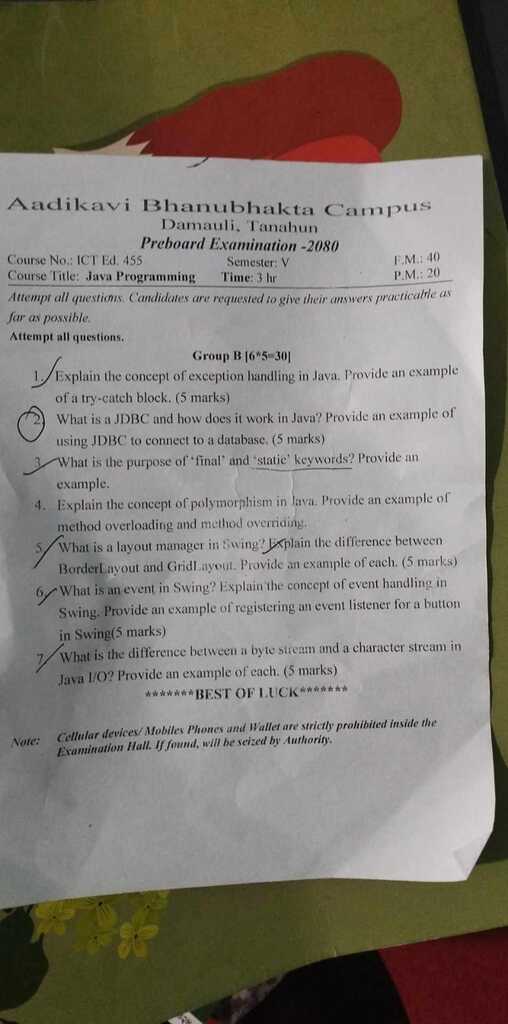
Working through authentic past papers helps bridge the gap between classroom lectures and exam expectations. This collection brings together Tribhuvan University Bachelor of Information and Communication Technology in Education (BICTE) 5th Semester old question papers for Java Programming (ICT.Ed.455), covering annual board exams and prominent campus internal examinations from 2076 to 2080 BS.
By reviewing these papers, you can familiarize yourself with both objective multiple-choice items and descriptive programming questions. Practicing regular past papers gives you the clarity needed to handle both theoretical explanations and laboratory code implementation with confidence.
BICTE 5th Semester Java Programming Question Papers 2076–2080


What the BICTE Java Programming Paper Covers
The examination papers in this course assess a blend of foundational Java mechanics and practical application programming. Students encounter questions testing Java virtual machine fundamentals, bytecode generation, memory organization, and the core differences between development kits and runtime environments.
Core object-oriented paradigms form the backbone of the subjective questions. You are expected to demonstrate class design, constructors, method overloading, method overriding, inheritance structures, and interface implementation through clean, error-free code snippets.
Robust program design is another significant focus area across these exam sets. Regular questions evaluate your understanding of exception handling hierarchies, thread life cycles, multithreading synchronization, and stream-based input-output processing for files and console operations.
Later units emphasize graphical user interfaces and database connectivity. The papers frequently challenge students to build basic interactive desktop interfaces using layout managers and event handlers, alongside implementing structured database connectivity routines using relational query operations.
Exam Tips for BICTE Java Programming
When practicing Java coding problems, always write your code by hand on paper before testing it inside an IDE. Board examinations require handwritten solutions, so practicing clean indentation, correct semicolon placement, and proper variable naming without IDE autocompletion prevents silly mistakes on exam day.
Pay close attention to differentiating closely related terms in your theoretical answers. Topics like method overloading versus overriding, abstract classes versus interfaces, and byte streams versus character streams frequently appear and can easily fetch full marks if supported with concise comparison tables and brief code examples.
Do not skip drawing architecture and life cycle diagrams. Visual illustrations of the Java virtual machine architecture, exception class hierarchies, and thread states immediately show the examiner that you understand the underlying runtime mechanics beyond surface-level syntax.
Allocate focused study time to database connectivity and graphical user interface event handling. Practicing standard database interaction sequences and common action listener registrations ensures you can tackle long programming questions swiftly during the final hour of your exam.
Frequently asked questions
What is the question paper format for TU BICTE 5th Semester Java Programming?
The examination consists of Group A featuring multiple-choice objective questions testing fundamental terminology, syntax, and concepts, followed by Group B containing descriptive and programming questions with internal choice options.
Which topics carry significant weight in the Java Programming ICT.Ed.455 exam?
Important recurring topics include object-oriented principles, constructor mechanisms, inheritance and interfaces, exception handling, multithreading, byte and character file streams, GUI creation with event handling, and basic JDBC database connectivity.
How should I write programming answers in the board exam?
Begin with a concise explanation of the concept, write clean Java code with proper class definitions and main method structure, and add brief comments explaining critical logic so the examiner can evaluate your programming understanding clearly.
Are internal campus examination papers helpful for final board preparation?
Yes, campus terminal and pre-board examinations from constituent and affiliated campuses closely follow the Tribhuvan University syllabus and question format, offering valuable additional practice questions and highlighting likely exam patterns.
About Noted Insights
Noted Insights was founded in 2022 by Ajay Mahato to provide university students in Nepal with reliable, accessible study materials, syllabi, and past question archives. We believe that quality education should be within reach for every learner regardless of geographical location or background, helping future IT educators and software developers build meaningful academic foundations.
We are constantly developing resources that support the learning journey of BICTE students across Nepal. Take your time practicing these Java problems, stay consistent in your revision routines, and approach your upcoming semester examinations with confidence and composure.


