
Stepping into university-level mathematics can feel intimidating during your first semester of BICTE, especially when balancing computer programming basics with formal mathematical proofs and calculations.
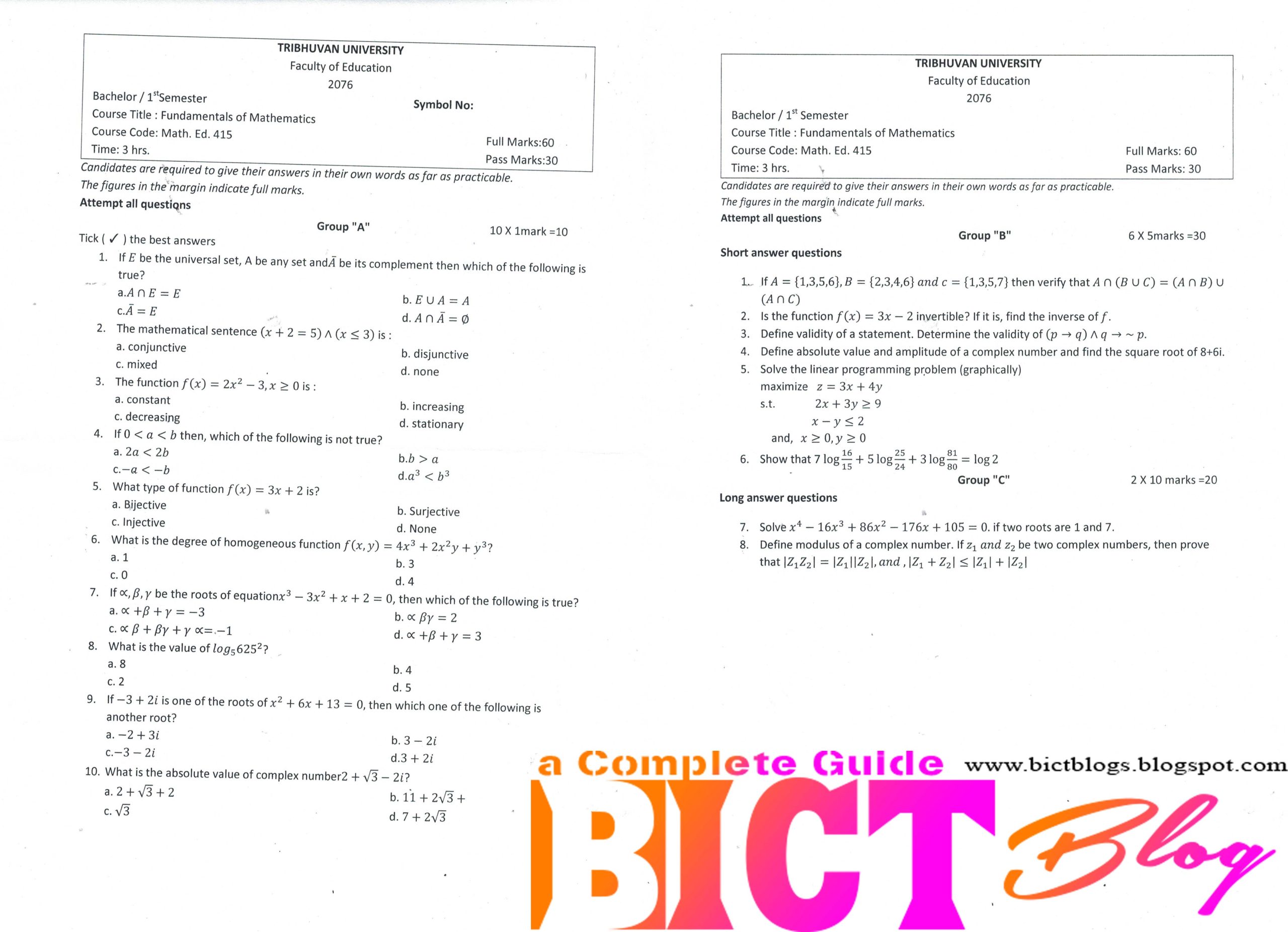
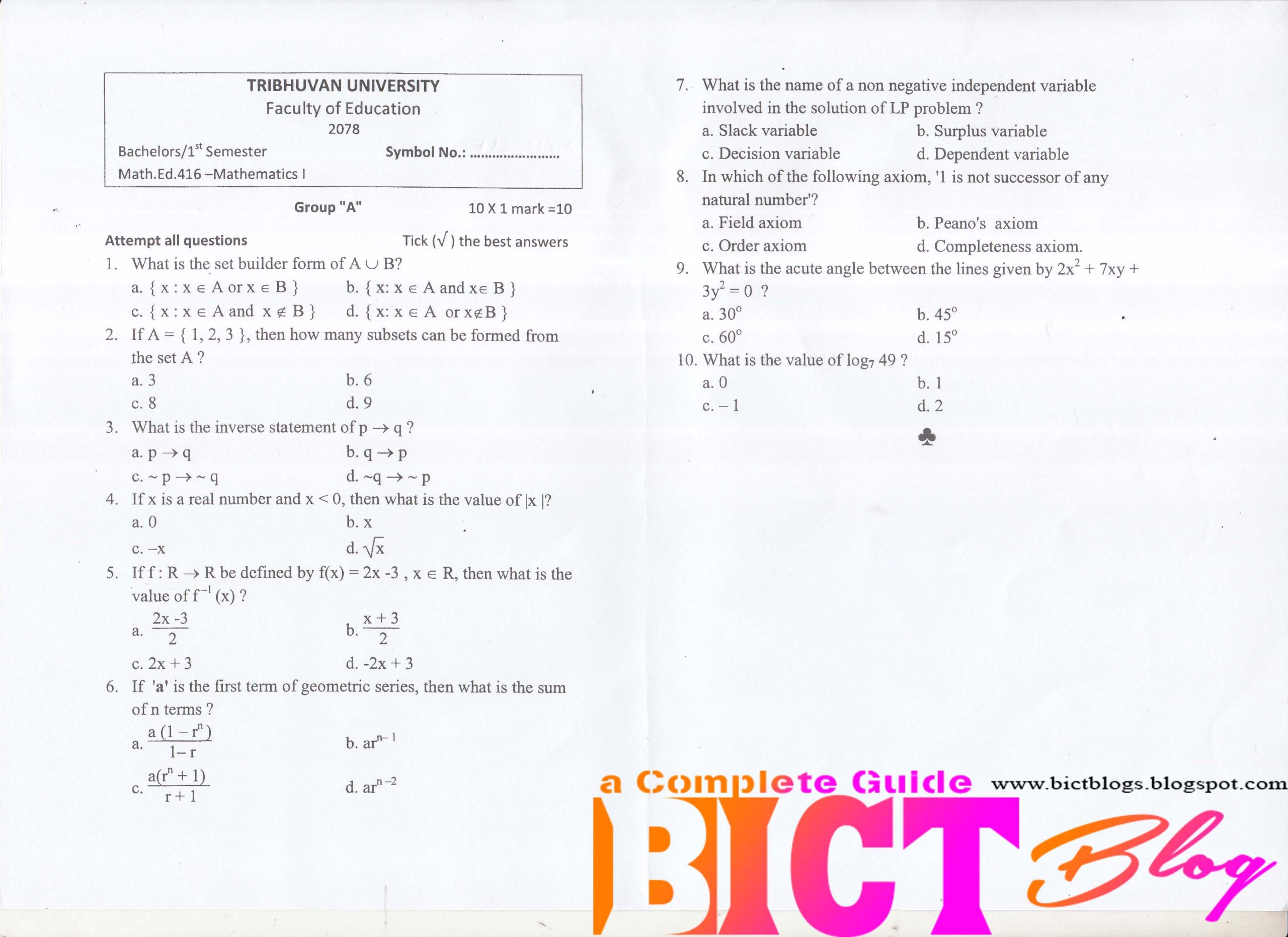
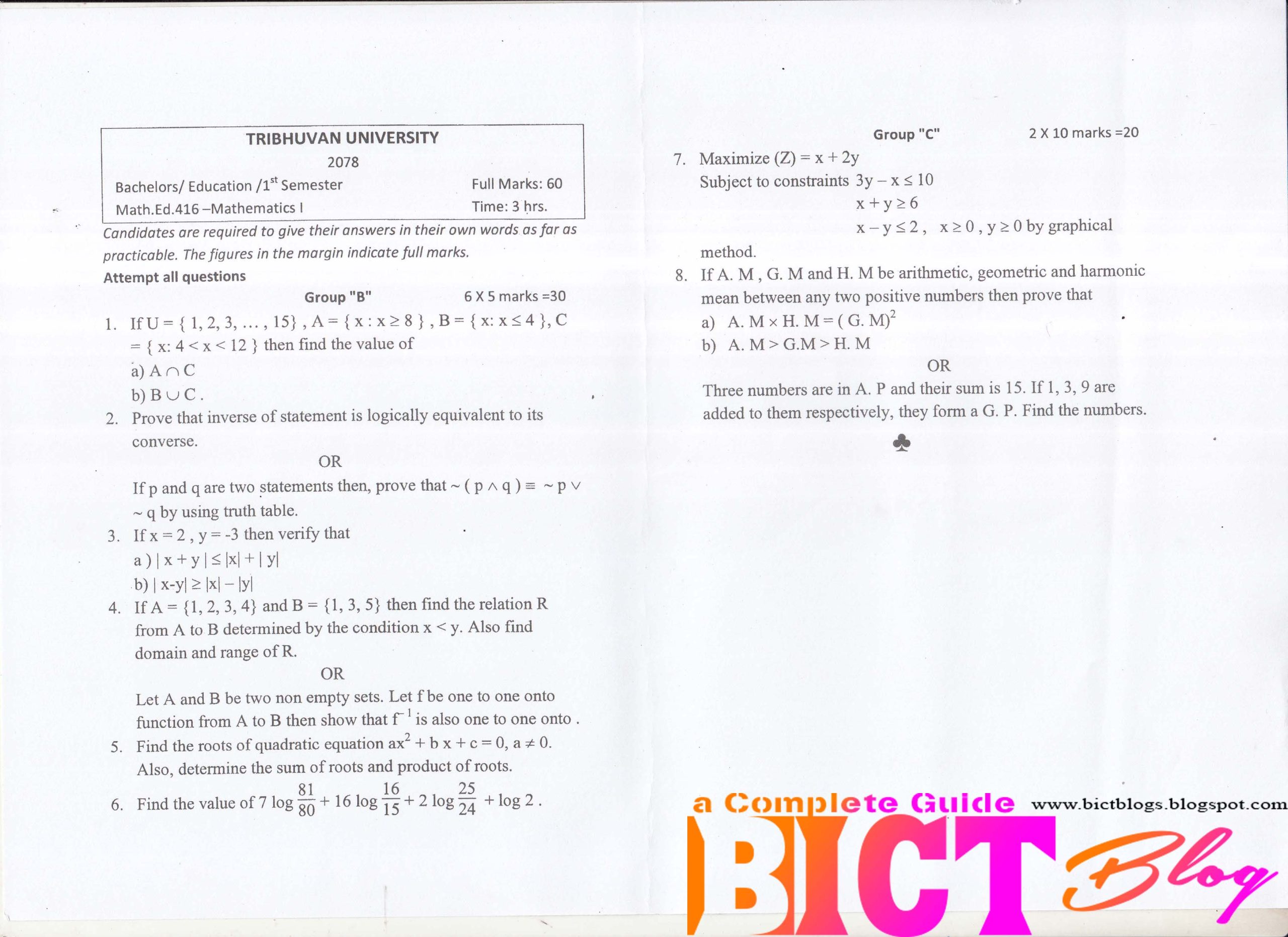
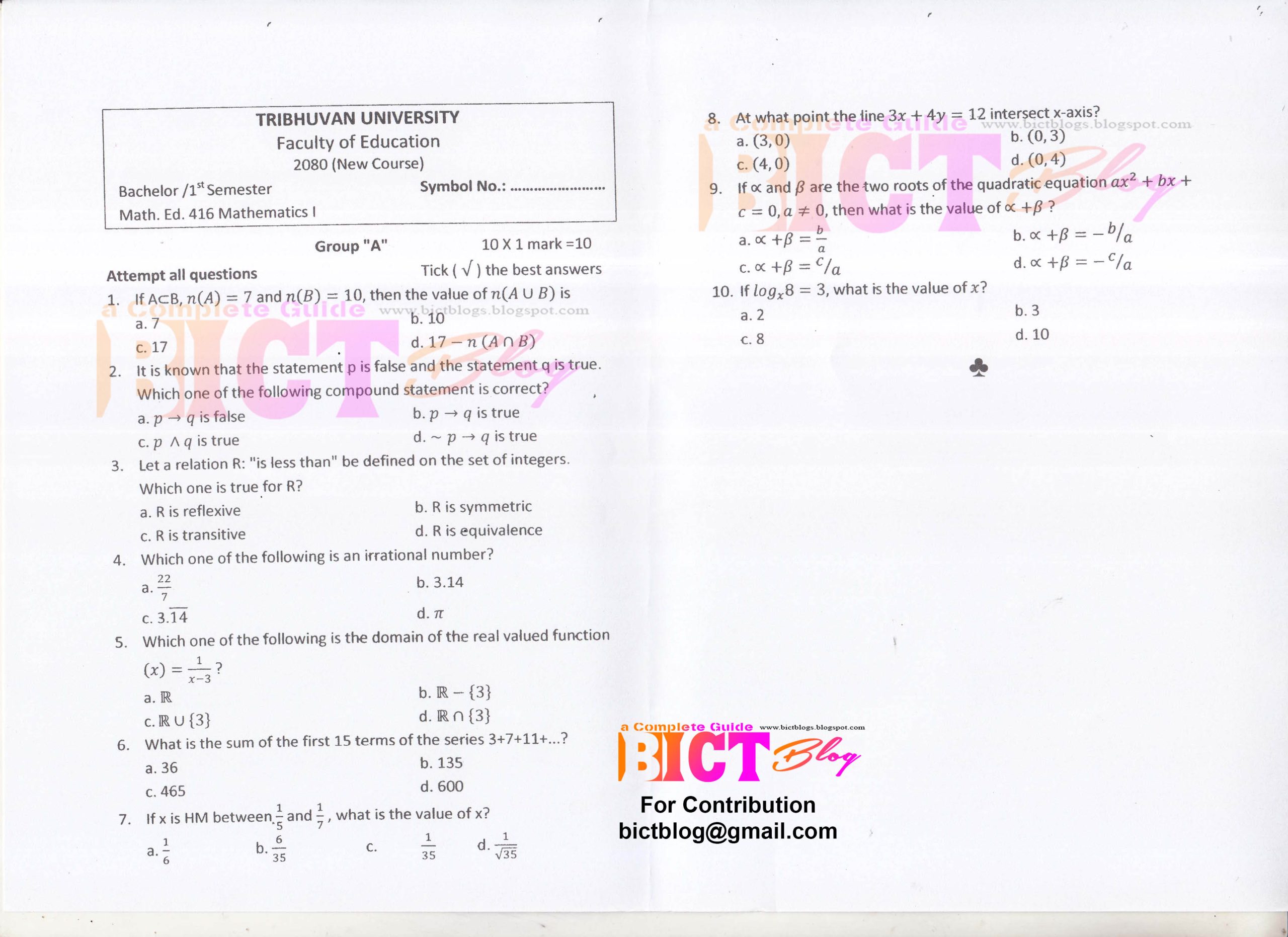
Tribhuvan University’s Bachelor of Information and Communication Technology in Education (BICTE) curriculum requires strong mathematical foundations to support upcoming computing courses. This board exam collection compiles past question papers for Mathematics I—initially titled Fundamentals of Mathematics under course code Math. Ed. 415 and later updated to Math. Ed. 416—covering exam years 2076 BS through 2080 BS.
Practicing authentic papers from the Faculty of Education provides a realistic preview of the board test structure. Whether you are revising multiple-choice items or multi-step proofs, working through these past exams will help you organize your study schedule effectively.
BICTE 1st Semester Mathematics I Question Papers 2076–2080


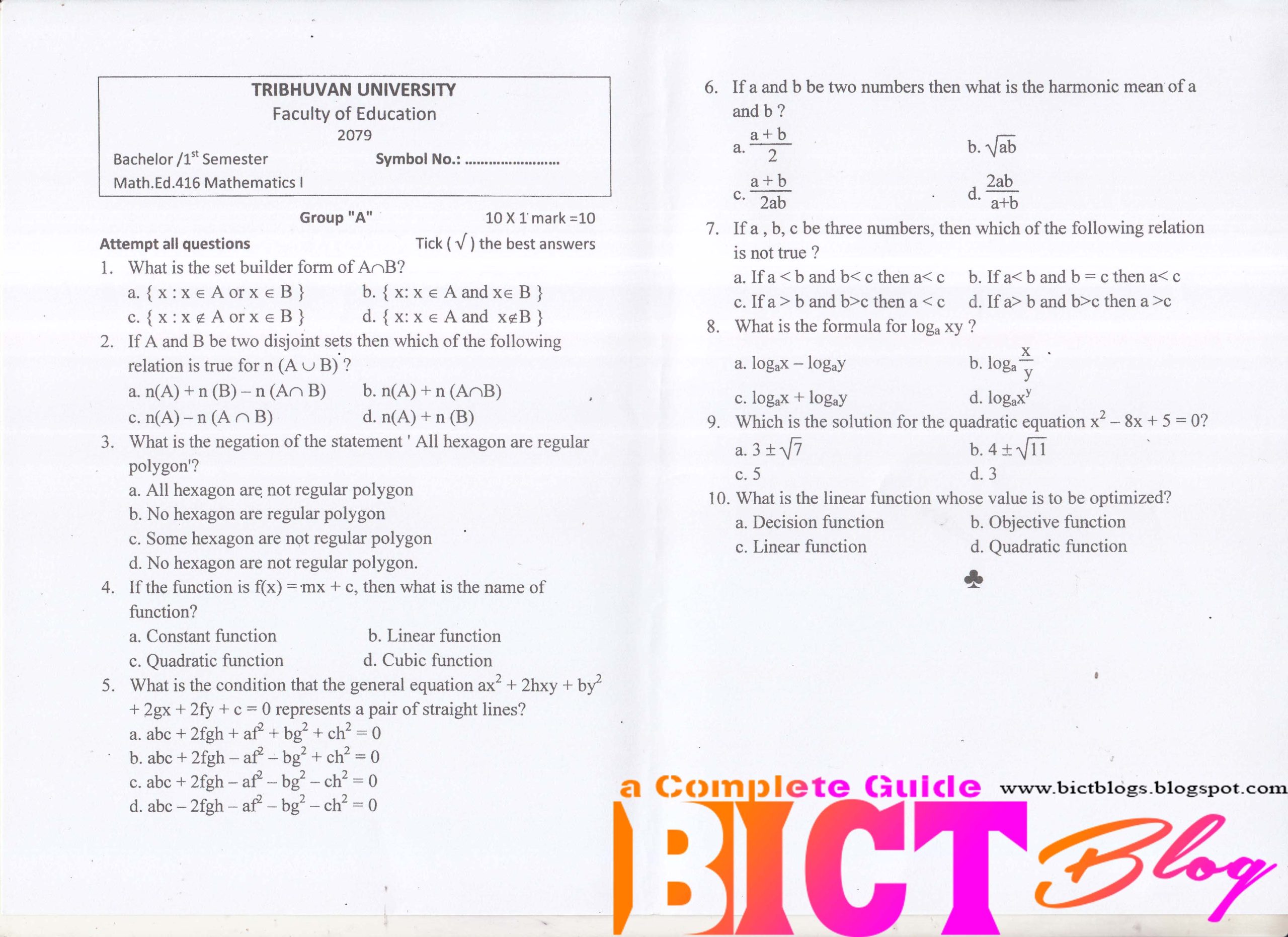

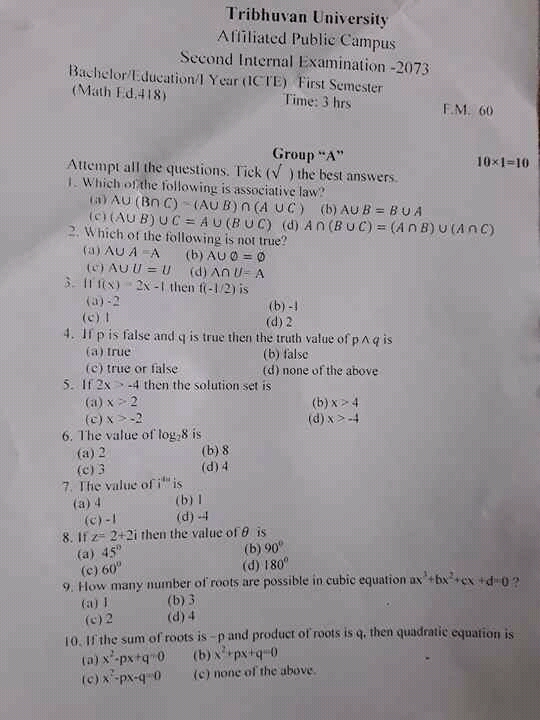
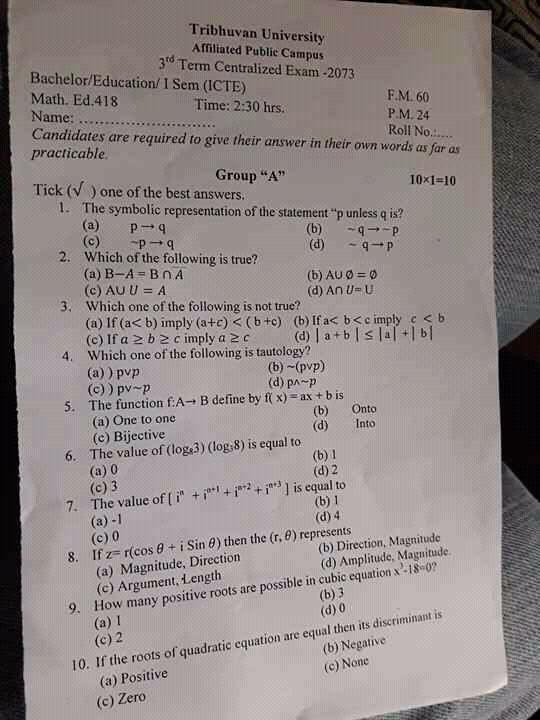
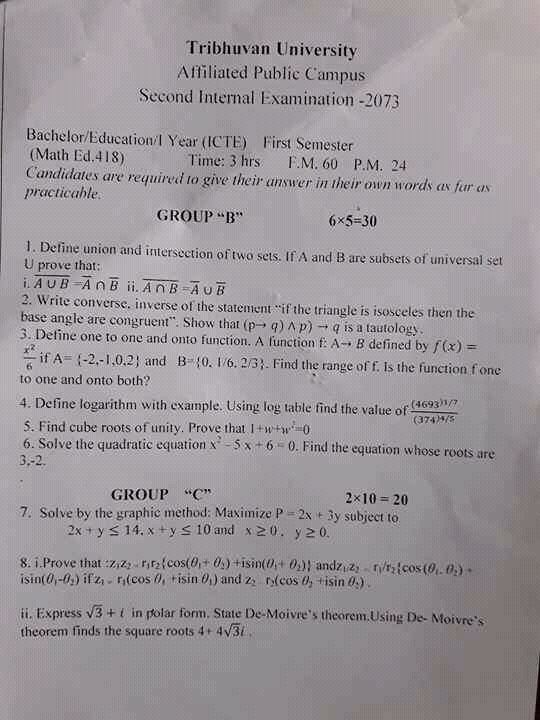


What the Mathematics I Papers Cover
The Mathematics I curriculum establishes essential analytical tools for future computing educators. Questions across these exam sessions emphasize foundational mathematical logic and set theory. You will encounter problems requiring you to construct truth tables, test statement validity, evaluate conditional propositions, and explore set operations alongside injective, surjective, and bijective relations.
A major portion of the syllabus focuses on real and complex number systems alongside polynomial algebra. Students are regularly asked to demonstrate properties of inequalities, prove the irrationality of numbers, examine quadratic roots, and simplify logarithmic expressions. The complex number questions assess your grasp of absolute values, amplitudes, square roots, and De Moivre’s theorem.
Another core area centers on progressions and optimization techniques. Exam sets frequently feature arithmetic, geometric, and harmonic progressions, asking candidates to verify mean relationships and calculate series sums. Furthermore, linear programming problems require clear graphical plotting to find feasible regions and optimize objective functions.
The examination format assesses both quick conceptual recall and rigorous analytical writing. Objective questions check knowledge of mathematical axioms, line equations, and fundamental properties, while subjective sections evaluate structured derivations and problem-solving steps.
Exam Preparation Tips for BICTE Mathematics I
Master propositional logic truth tables and core definitions early during your revision. Questions on tautologies, contrapositives, and argument validity appear regularly and offer straightforward marks when your truth tables are tidy and connective rules are applied correctly.
Practice graphing linear inequalities and identifying feasible regions by hand before the exam. For linear programming problems, use a ruler to draw straight boundary lines, shade the feasible solution area neatly, and test each corner vertex to determine the optimal value.
Dedicate focused study time to algebraic proofs and logarithmic properties. Prepare thoroughly to prove standard results, such as the irrationality of surds or relationships between arithmetic, geometric, and harmonic means. Write each intermediate step clearly to secure full partial credit.
Treat the multiple-choice objective section with equal priority during your preparation. Rapid recall of set builder forms, progression formulas, and complex number rules will allow you to complete the opening group quickly and save time for lengthy calculations.
Frequently asked questions
What course codes are used for BICTE 1st Semester Mathematics?
In earlier Tribhuvan University exam sessions (such as 2076 and 2077 BS), this course was titled Fundamentals of Mathematics under course code Math. Ed. 415. In subsequent sessions under the revised syllabus, it is designated as Mathematics I under course code Math. Ed. 416.
What is the question pattern for the TU BICTE Mathematics I board exam?
The Faculty of Education board examination carries 60 full marks across a 3-hour test. It consists of Group A with 10 objective questions (1 mark each), Group B with 6 short-answer problems (5 marks each), and Group C with 2 long-answer questions (10 marks each).
How can I prepare for the sequences and linear programming problems?
Review relationships among arithmetic, geometric, and harmonic means (AM, GM, and HM) and practice calculating series sums. For linear programming, practice plotting boundary lines accurately and testing corner points of feasible regions.
Where can I find other BICTE 1st semester old questions?
Noted Insights offers free access to past question collections, syllabi, and study notes for other BICTE 1st semester courses, including Introduction to Information Technology and Programming Concept with C.
About Noted Insights
Noted Insights was founded in 2022 by Ajay Mahato to provide university students in Nepal with free, dependable academic resources. Offering college notes, syllabi, past exam papers, and practical IT materials, the platform strives to empower learners to build lasting knowledge and excel in their chosen careers.
We believe education transforms lives, and high-quality learning materials should be accessible to every student regardless of location. As you master your first-semester mathematics topics and embark on your journey in computer education, stay consistent in your practice and approach your board examinations with pride!

