
Tackling university-level calculus, abstract algebraic structures, and discrete mathematics during your second semester can feel challenging when Tribhuvan University board exams are just around the corner. Solving authentic previous exam papers is the most reliable way to demystify complex formulas, recognize recurring question patterns, and build genuine exam confidence.
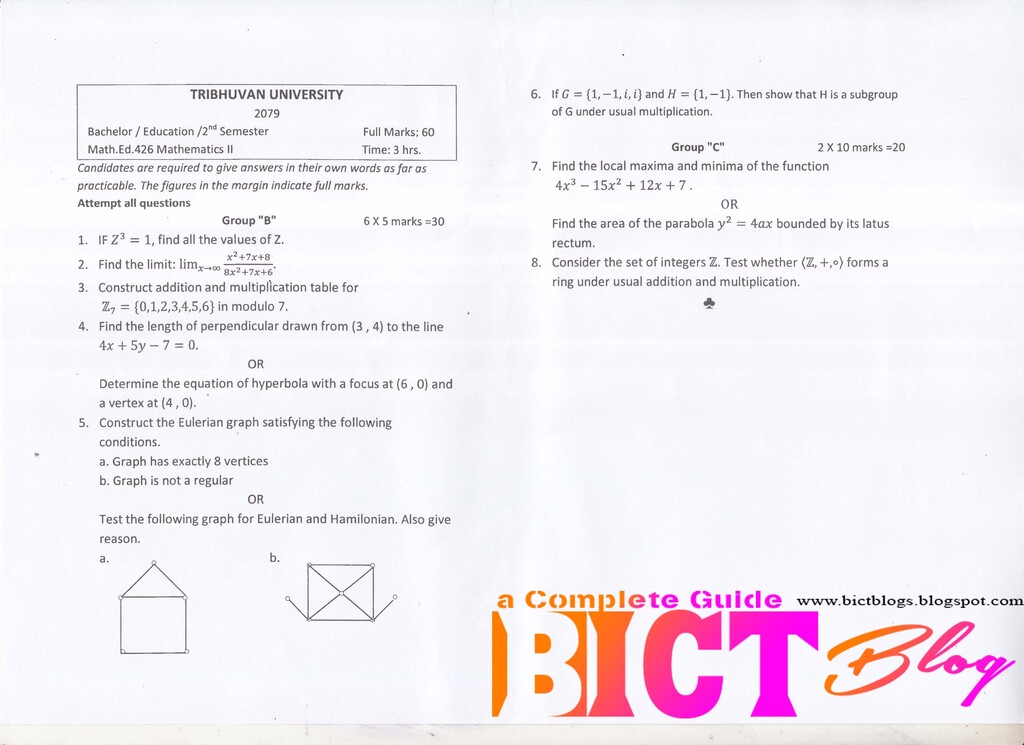
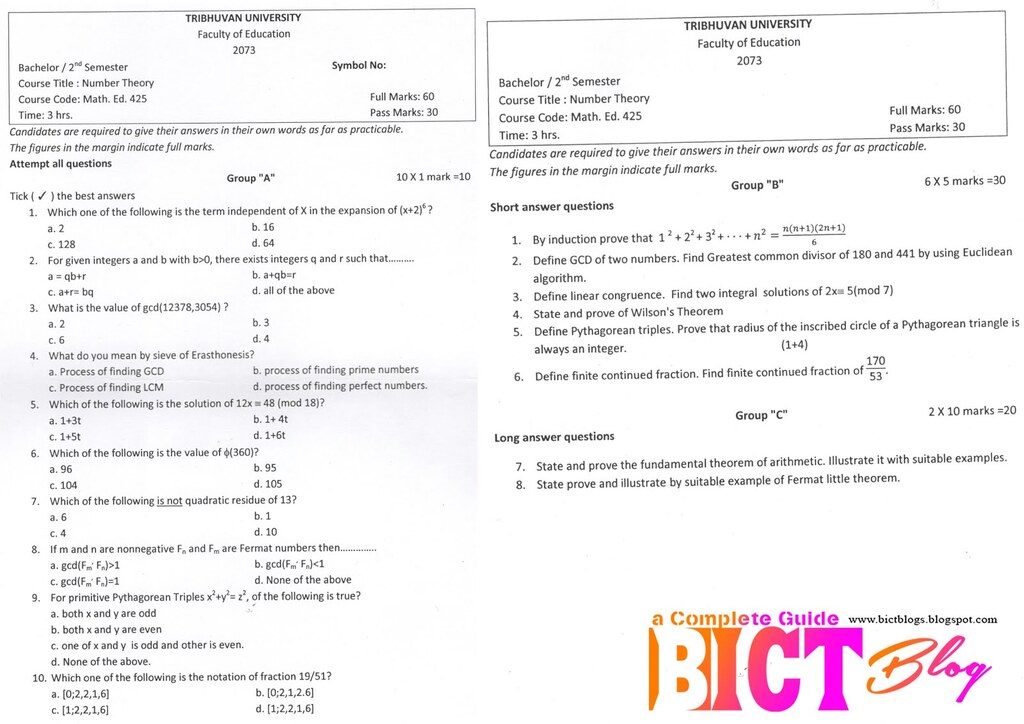
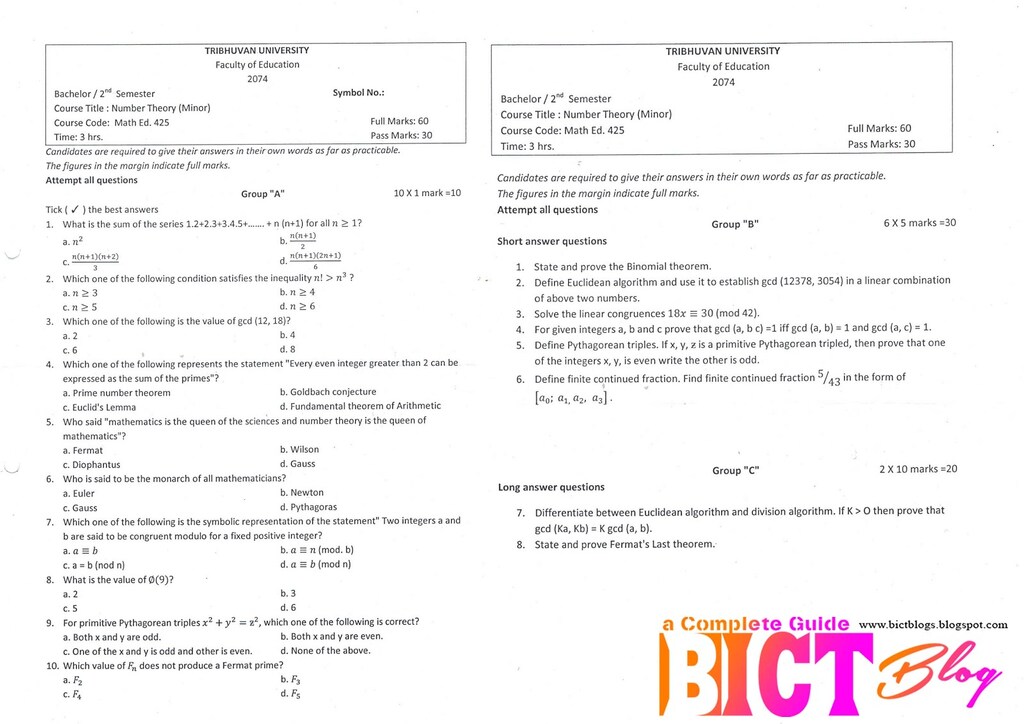
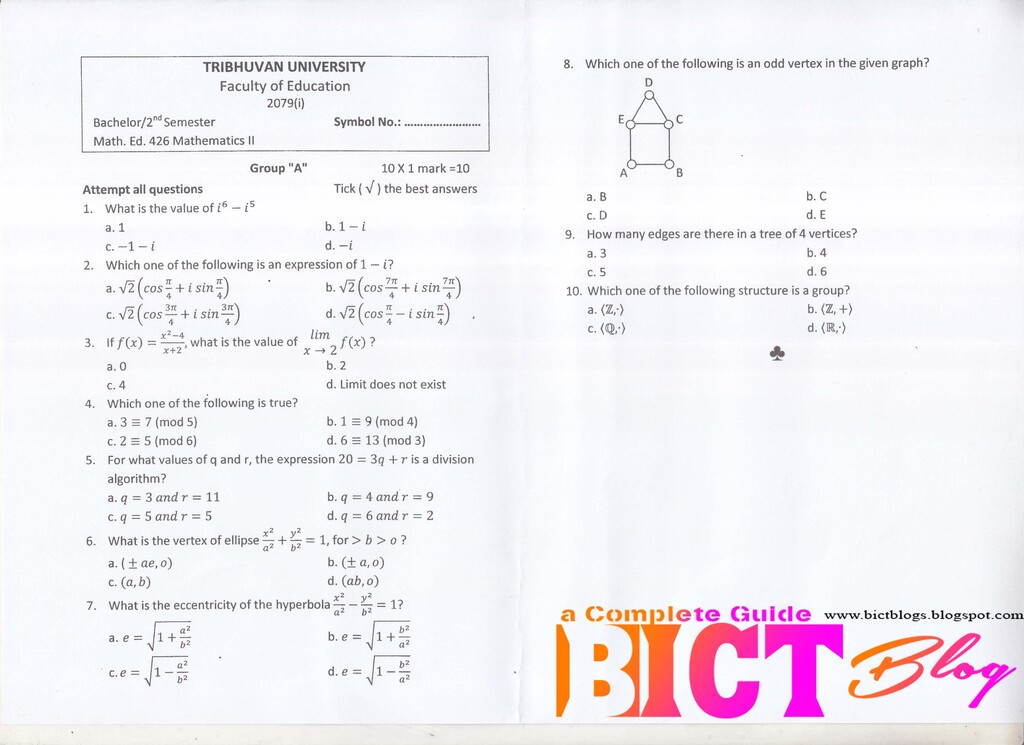
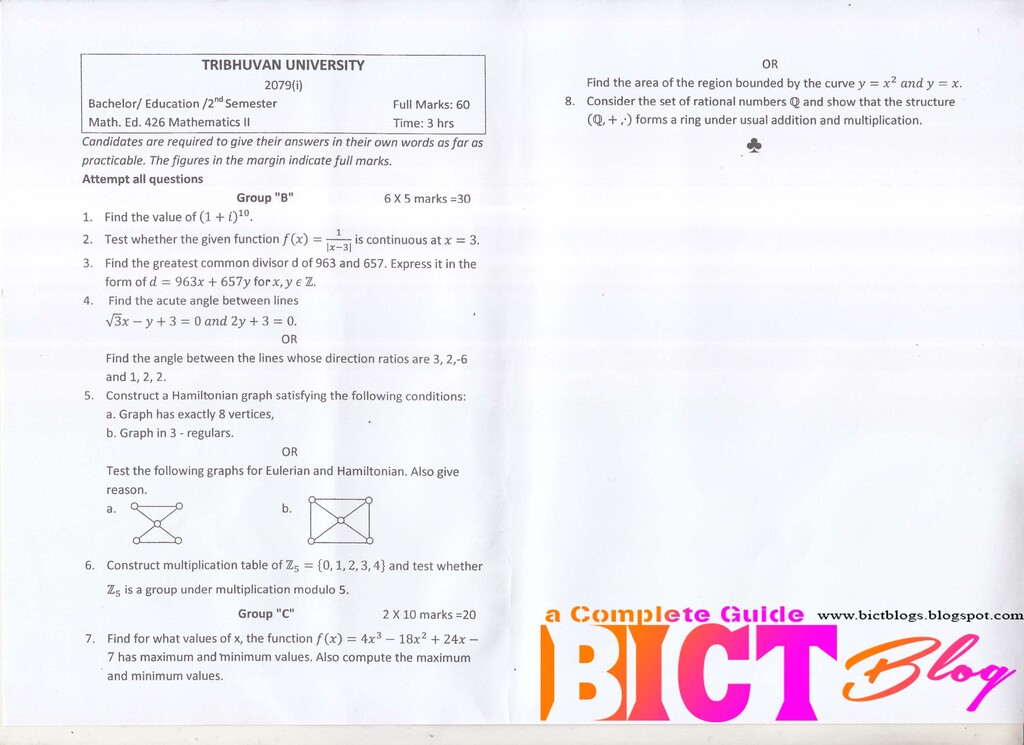
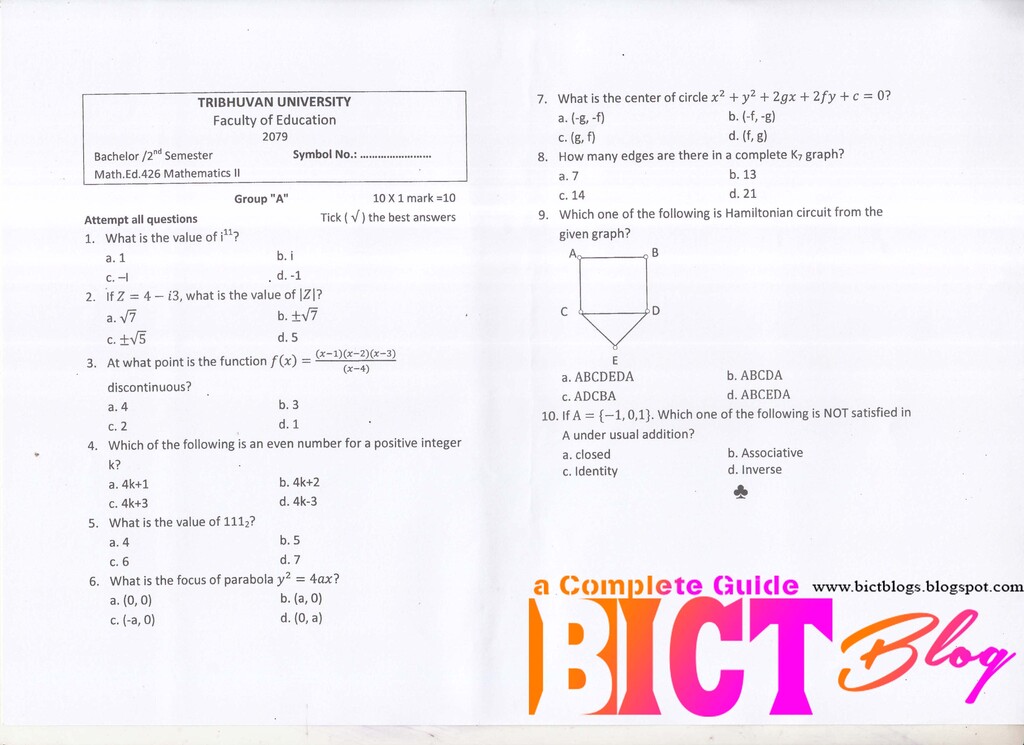
This resource brings together original Tribhuvan University (TU) Faculty of Education question papers for the Bachelor of Information and Communication Technology Education (BICTE) and B.Ed second semester. The collection features recent Mathematics-II (Math.Ed. 426) board papers from 2079 BS alongside earlier foundational Number Theory (Math. Ed. 425) papers from 2073 and 2074 BS.
By reviewing these authentic sets, students can observe how theoretical concepts are tested across objective questions, structured derivation problems, and long analytical proofs. Whether you are revising modular arithmetic tables or polishing your coordinate geometry proofs, these past questions serve as an indispensable study benchmark.
TU BICTE 2nd Semester Mathematics II Past Papers (2073–2079 BS)
What the Mathematics II and Number Theory Papers Cover
The question papers in this collection assess foundational topics across algebra, calculus, coordinate geometry, and discrete mathematics. In complex analysis and algebra, problems focus on properties of complex numbers, evaluating integer powers and roots of unity using de Moivre’s theorem, constructing addition and multiplication tables in modular systems, and verifying group or ring properties for given numerical sets.
Calculus and analytical geometry components evaluate students on evaluating limits of rational functions, determining points of continuity and discontinuity, and identifying local extrema of cubic polynomial functions. In geometry, questions explore equations of straight lines, perpendicular distances from points, angles between intersecting lines using direction ratios, and characteristic properties of conics including parabolas, ellipses, and hyperbolas.
Discrete mathematics and graph theory topics test your ability to construct and verify Eulerian and Hamiltonian graphs under specific vertex and degree constraints. Students are also expected to compute edge counts in complete graphs and trees, evaluate binary representations, and apply fundamental graph traversal principles.
The included number theory examinations emphasize divisibility and prime number theory. Key topics include applying the Euclidean algorithm to determine greatest common divisors and express them as linear combinations, solving linear congruences, working with continued fractions, and mastering core theorems such as the fundamental theorem of arithmetic and classical primality results.
Exam Preparation Tips for BICTE Mathematics II
Begin your revision by practicing systematic algebraic proofs. When asked to show whether a set forms a group, subgroup, or ring under specified operations, write out each axiom explicitly—closure, associativity, identity, and inverse elements—rather than skipping intermediate verification steps.
For calculus and optimization problems, always present your differentiation steps clearly. When calculating local maxima and minima or determining the bounded area between curves using definite integration, sketch a quick preliminary curve diagram and state your integration limits accurately to avoid sign errors.
Pay close attention to graph theory definitions and properties. Be ready to construct graphs matching specific criteria, such as regular graphs or graphs with given vertex counts, and ensure you can explain why a given structure is or is not Eulerian or Hamiltonian using vertex degrees and connectivity arguments.
Dedicate time to mastering number theory algorithms and linear congruences. Practice working the Euclidean algorithm backwards to express the greatest common divisor in linear combination form, and review formal statements and proof structures for key theorems so that you can reproduce them precisely under exam time pressure.
Frequently asked questions
What is the examination pattern for TU BICTE 2nd semester Mathematics II?
The examination is evaluated out of 60 full marks over a three-hour duration and consists of three distinct groups. Group A contains 10 objective multiple-choice questions carrying one mark each, Group B features 6 short-answer questions carrying 5 marks each (with internal choices), and Group C offers 2 comprehensive analytical questions carrying 10 marks each.
Why does this resource include Number Theory question papers?
In earlier Tribhuvan University Faculty of Education curricula, Number Theory (Math. Ed. 425) was taught as the core mathematical component in the second semester before the syllabus was revised into the current Mathematics-II (Math. Ed. 426) course. Practicing these earlier papers provides invaluable training on modular arithmetic, proof techniques, and divisibility algorithms that remain central to the curriculum.
How should I practice for the objective questions in Group A?
Group A tests foundational definitions, mathematical formulas, and quick calculations across graph theory, complex numbers, coordinate geometry, and algebraic structures. Focus on memorizing vertex-edge relationships, conic properties, group axioms, and algebraic identities to solve these items swiftly during the opening minutes of your exam.
Where can students find the official BICTE 2nd semester syllabus and reference books?
Official curriculum outlines and prescribed textbooks are published by the Tribhuvan University Faculty of Education Dean’s Office and campus departments. Noted Insights also hosts updated subject syllabi, semester guides, and companion study notes across all semesters of the BICTE program.
About Noted Insights
Noted Insights was founded in 2022 by Ajay Mahato to provide university students and educators across Nepal with dependable notes, past question archives, detailed syllabi, and practical IT learning resources. The platform was created on the firm conviction that quality education transforms lives, and that essential study materials must remain open and freely accessible to all learners regardless of geographical location or financial background.
By compiling organized board exam collections for BICTE and B.Ed programs, Noted Insights aims to support you in overcoming academic hurdles, building rigorous problem-solving habits, and realizing your highest potential in technology and education. Stay consistent in your daily problem practice, maintain confidence in your mathematical preparation, and do your best in the upcoming examinations.


