
Working through iterative calculations by hand can easily overwhelm you when semester finals approach, but solving actual past exam problems brings clarity and confidence. Practicing authentic test questions helps you identify the exact numerical methods Tribhuvan University examiners focus on year after year.
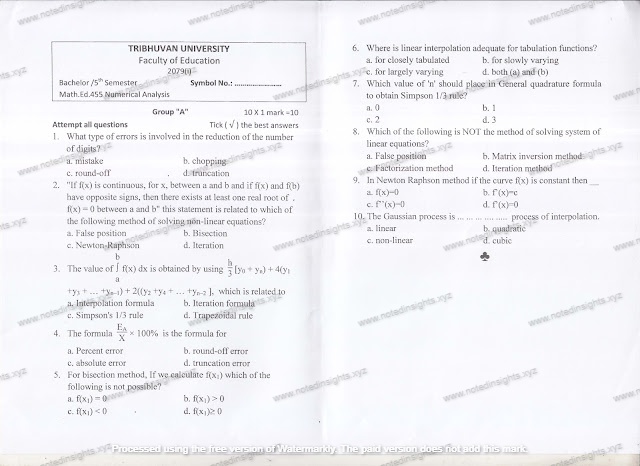
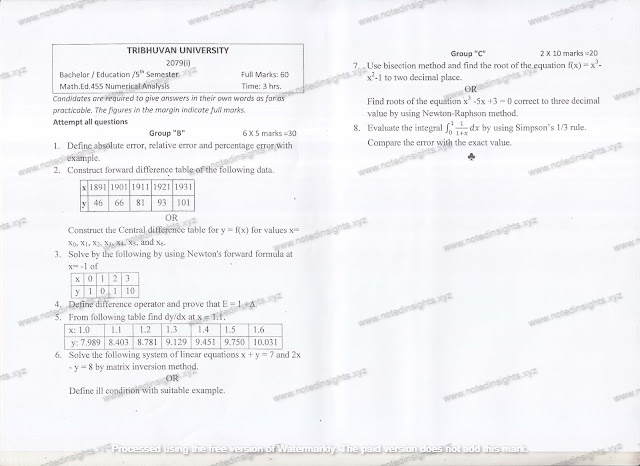
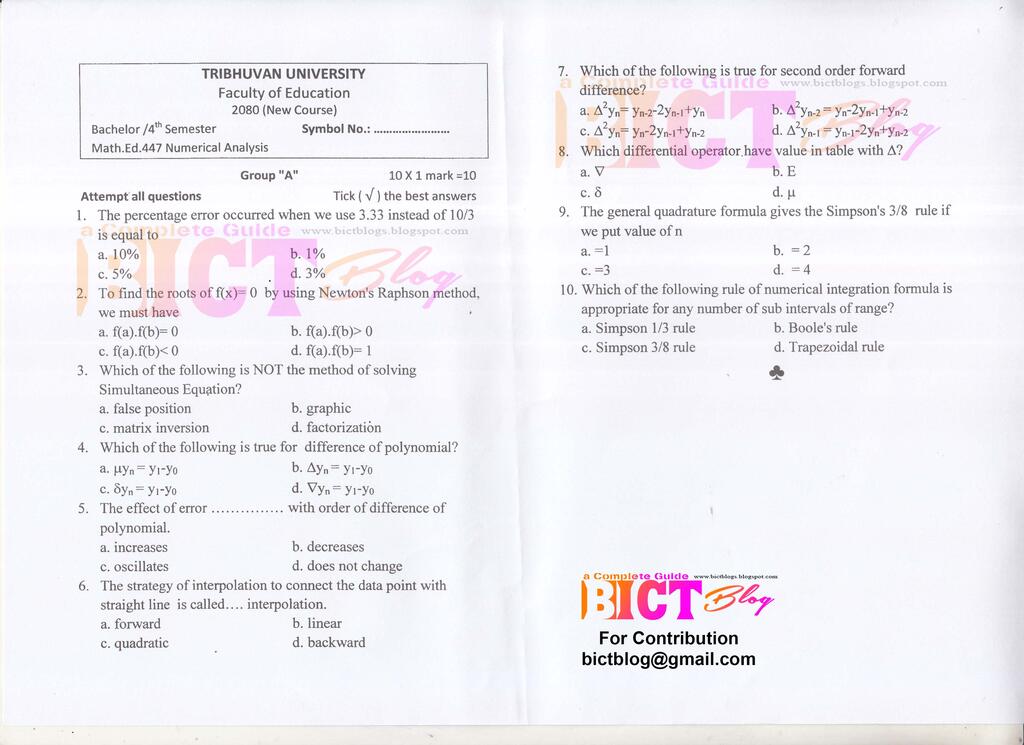
This resource gathers Tribhuvan University BICTE and B.Ed old question papers for Numerical Analysis covering 2076 BS through 2080 BS. The collection brings together university board exam papers alongside pre-board and terminal test papers from affiliated institutions such as Janamaitri Multiple Campus and Balkumari College.
Whether you are enrolled in the BICTE 4th semester or studying Math.Ed.455 in the B.Ed program, reviewing these papers gives you an authentic feel for both multiple-choice questions and long analytical problems. Working through these past papers will sharpen your problem-solving speed and prevent costly rounding mistakes.
BICTE Numerical Analysis Question Papers Collection (2076–2080 BS)






What the Numerical Analysis Question Papers Cover
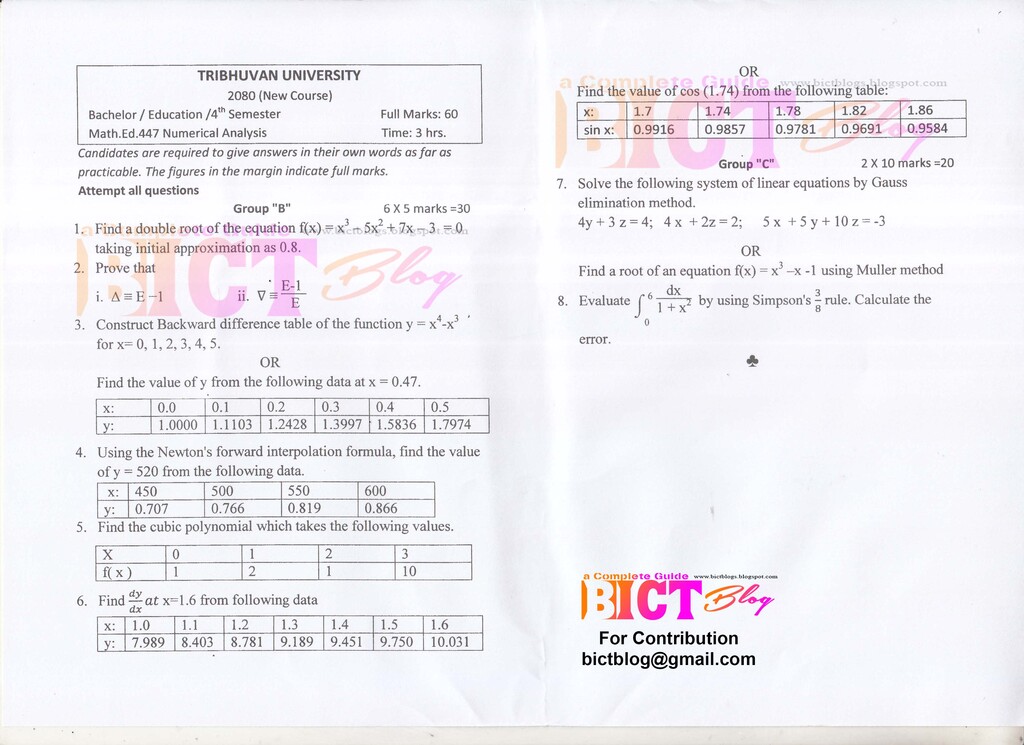
The papers focus heavily on fundamental numerical computation principles, starting with error analysis and root-finding techniques. Students must understand truncation and round-off errors, compute relative and percentage errors, and apply significant digits. In addition, questions regularly ask candidates to locate roots of nonlinear equations using iterative algorithms like the bisection method, Newton-Raphson technique, and false position method.
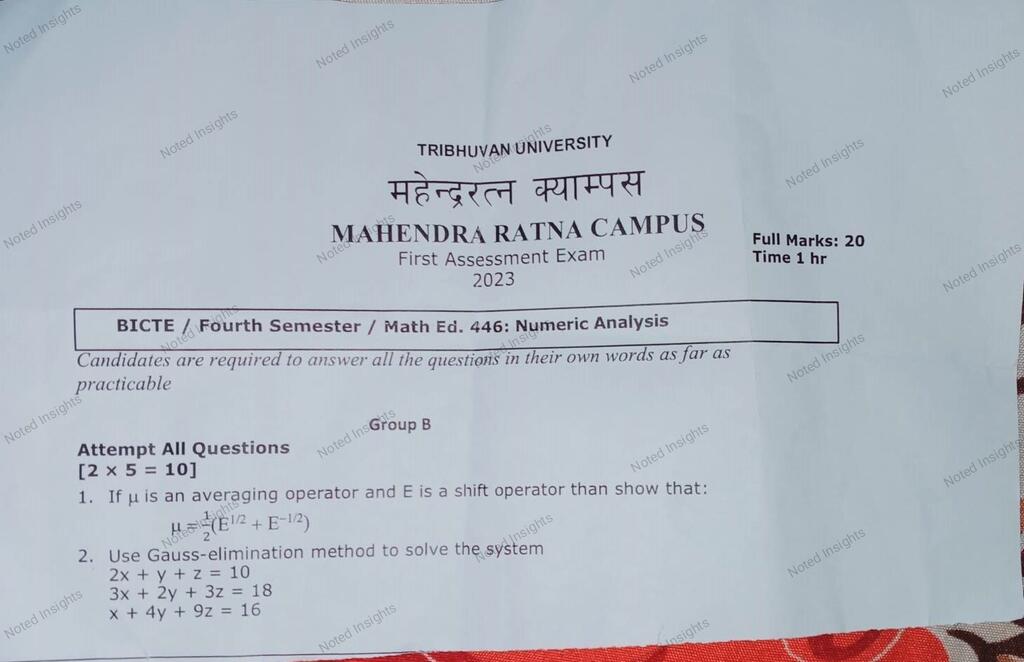
Another core area represented throughout these papers is finite difference operators and polynomial interpolation. Questions explore identities connecting forward, backward, central, shift, and averaging operators, requiring theoretical proofs alongside difference tables. Practical problems challenge students to interpolate values for evenly and unevenly spaced datasets using Newton’s forward and backward formulas, divided differences, and central difference formulas.
Numerical differentiation and quadrature form a substantial part of both objective questions and analytical tasks. Candidates evaluate derivatives from tabular data and compute definite integrals using classical formulas like the Trapezoidal rule and Simpson’s rules while estimating computational errors. The papers also cover systems of linear algebraic equations, asking learners to apply methods such as Gauss-Jordan elimination, matrix inversion, and Gauss elimination.
By blending conceptual multiple-choice items with multistep calculations, these papers test theoretical comprehension and calculation accuracy. Practicing them allows students to observe recurring patterns, recognize examination structures, and master the precision needed to handle numerical calculations under timed conditions.
Exam Preparation Tips for Numerical Analysis
Master your scientific calculator well before entering the examination hall. Iterative methods like Newton-Raphson require evaluating functions across several cycles. Keep your calculator set to radian mode whenever evaluating trigonometric functions, record intermediate steps clearly, and maintain consistent decimal places to avoid compounding round-off errors.
Dedicate focused time to memorizing identities connecting the shift operator, forward difference, backward difference, and averaging operator. Questions asking for algebraic proofs of these operator relationships appear frequently and offer reliable marks. When constructing difference tables, keep columns neatly aligned and double-check differences between successive rows before applying interpolation formulas.
When solving numerical integration problems using Simpson’s rules or the Trapezoidal method, always tabulate coordinates systematically before plugging them into the formula. Verify whether the question specifies the step size or requires a specific number of intervals, as miscounting strips leads to wrong weightings.
Divide your exam time strategically between quick conceptual questions and lengthy calculations. Objective questions can be answered promptly, leaving you ample time to execute multi-step Gauss-Jordan eliminations or iterative systems without rushing. Neat handwriting, clear formula statements, and boxed final answers make your solution steps easy to evaluate.
Frequently asked questions
Which semesters include Numerical Analysis under Tribhuvan University?
Numerical Analysis is taught in the BICTE 4th semester and as Math.Ed.455 in the B.Ed 5th semester under Tribhuvan University’s Faculty of Education. Because both programs share similar numerical methods syllabi, past papers from both curricula provide effective exam practice.
What types of questions appear in the TU Numerical Analysis board exam?
The exam features objective multiple-choice questions assessing definitions and operator identities, short numerical problems involving difference tables or single iterations, and long problem-solving questions covering systems of linear equations and numerical integration.
How should I prepare for Newton-Raphson and interpolation questions?
Practice deriving and applying the iteration formula while ensuring initial approximations bracket or converge toward the root. For interpolation, practice constructing forward and backward difference tables and choosing the right formula based on whether the target value lies near the top or bottom of the table.
Where can I find complete solutions and notes for BICTE 4th semester subjects?
Noted Insights publishes question collections, reference notes, and curriculum guides for BICTE and education programs. You can browse the relevant semester categories on the website to access syllabus breakdowns and study materials.
About Noted Insights
Noted Insights was founded by Ajay Mahato in 2022 with the belief that education transforms lives and that high-quality learning resources should be accessible to everyone, whatever their background or location. By offering college notes, syllabi, references, and past questions, the platform strives to empower learners with the knowledge and skills needed to achieve their goals and excel in their careers.
Our vision is to serve as a leading educational provider and create a dynamic learning community where students engage with peers and mentors to explore new ideas and pursue their passions. Tackle every numerical problem with patience, and approach your university examinations with confidence!

