
Preparing for university mathematics examinations can feel daunting when textbook formulas do not reveal how questions actually appear in the final exam hall. For Tribhuvan University BICTE students, working through authentic past question papers is the most reliable way to turn theoretical concepts into confident problem-solving skills.
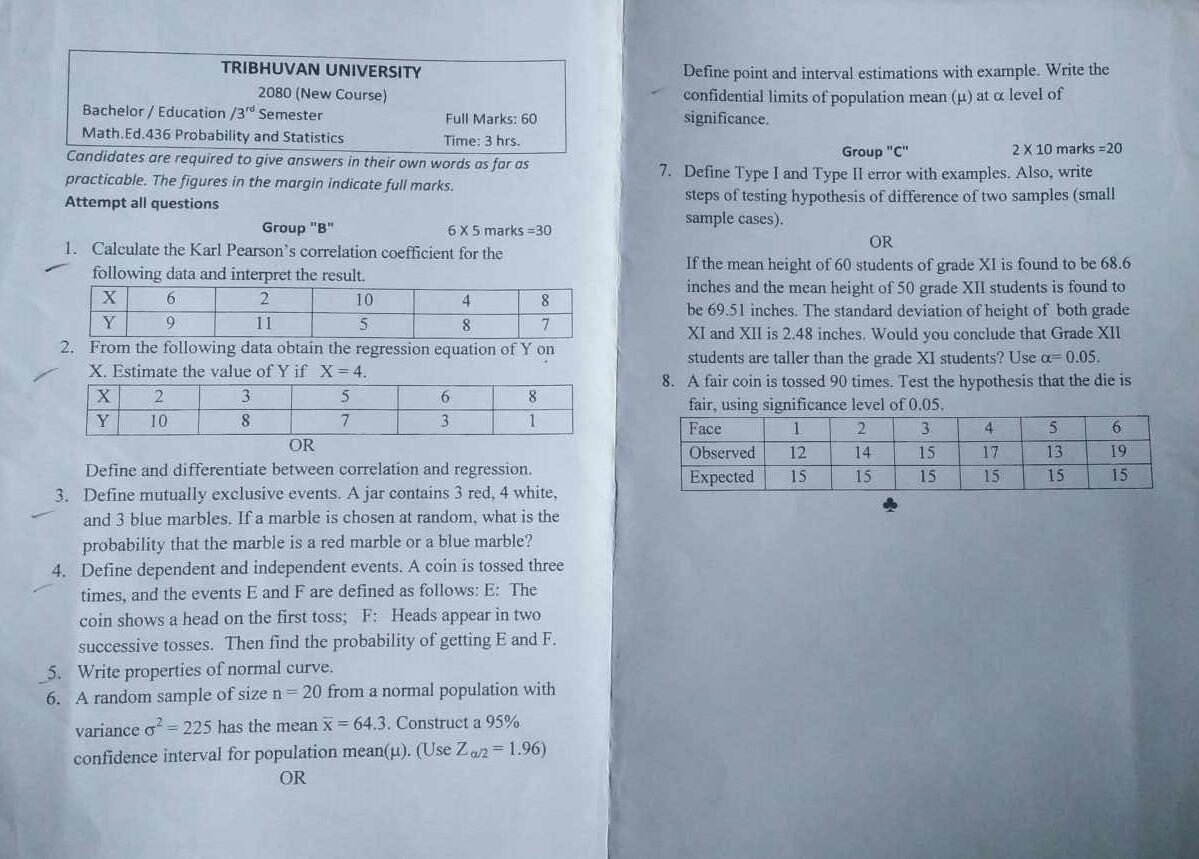
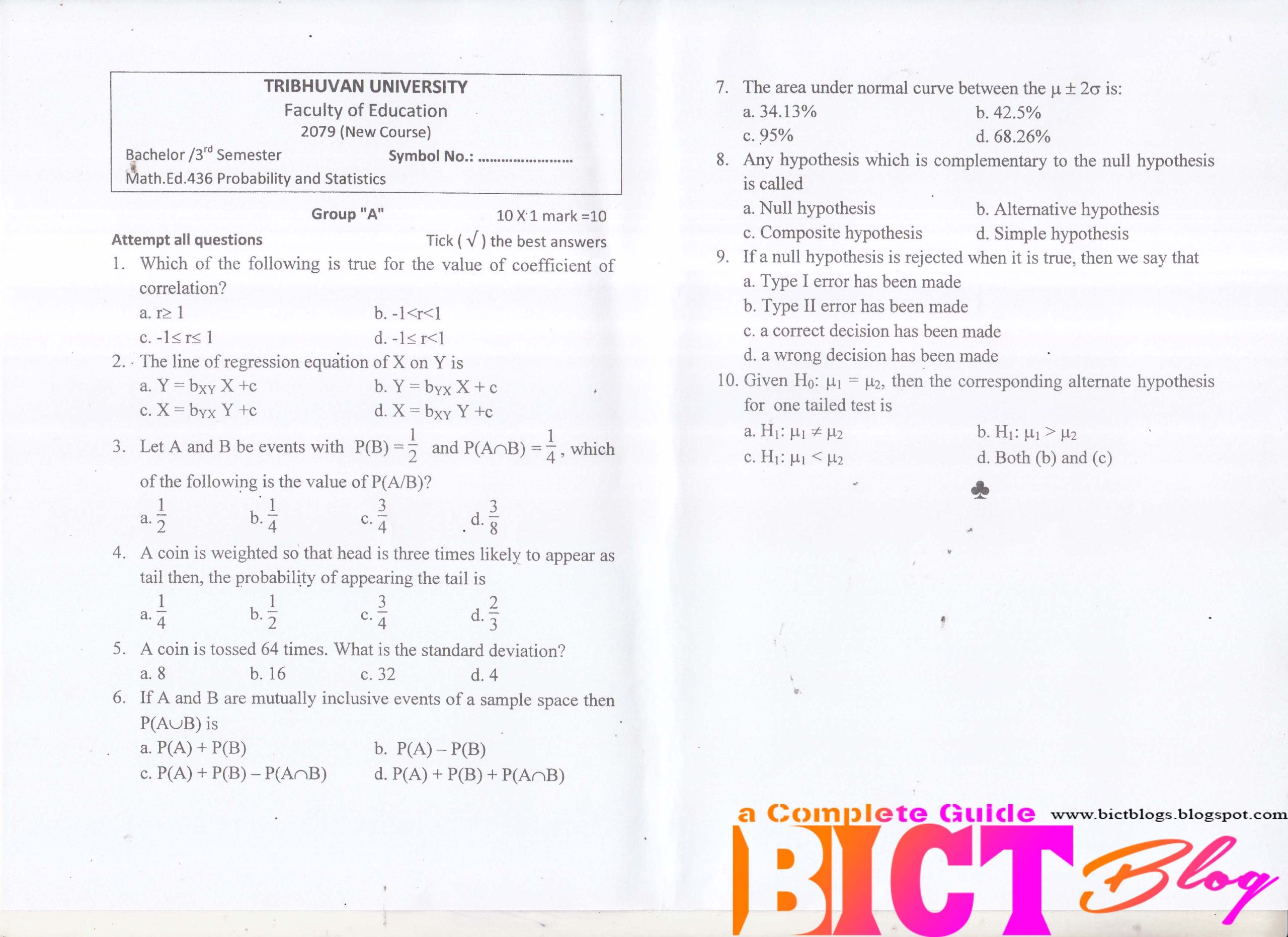
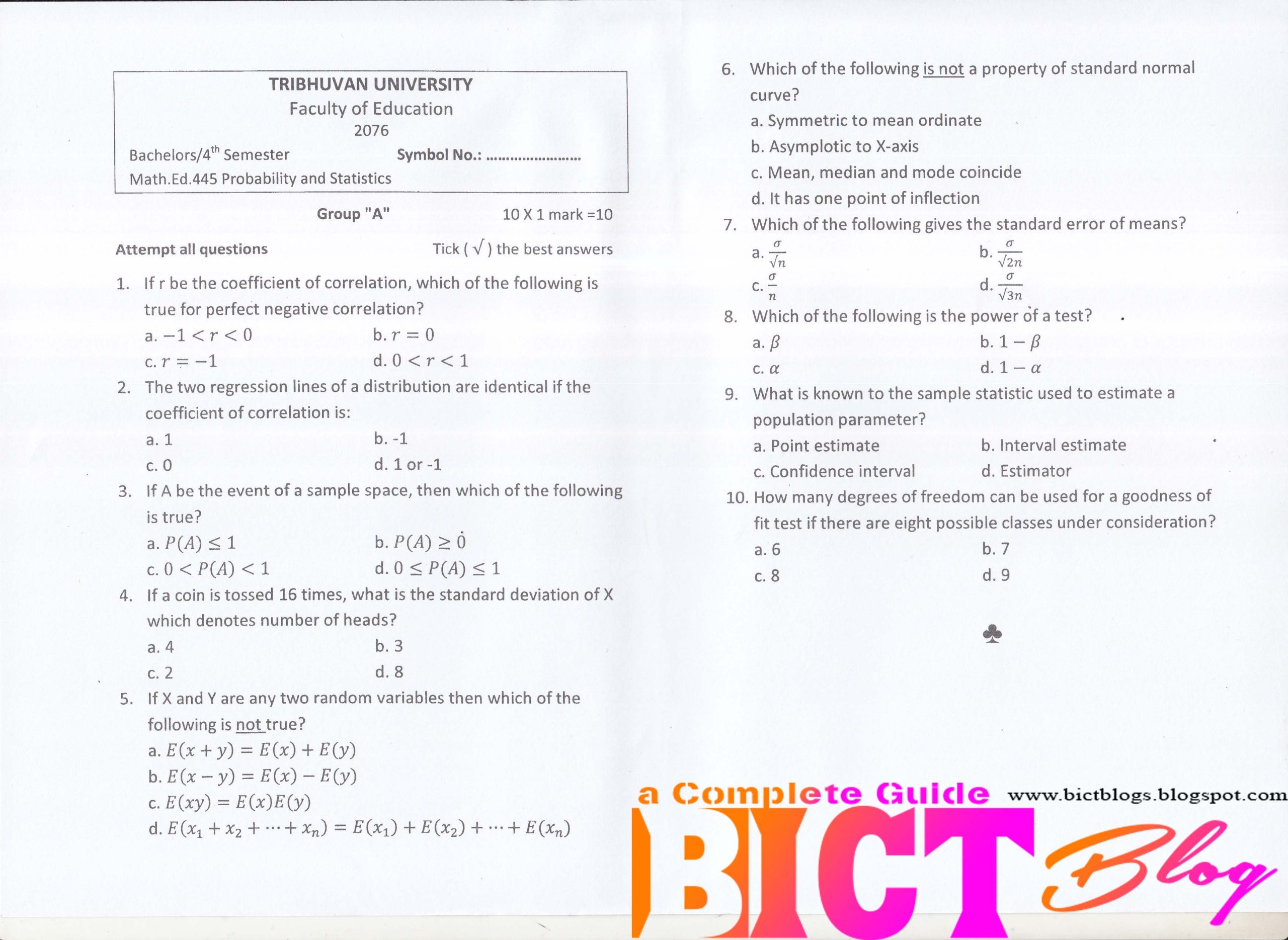
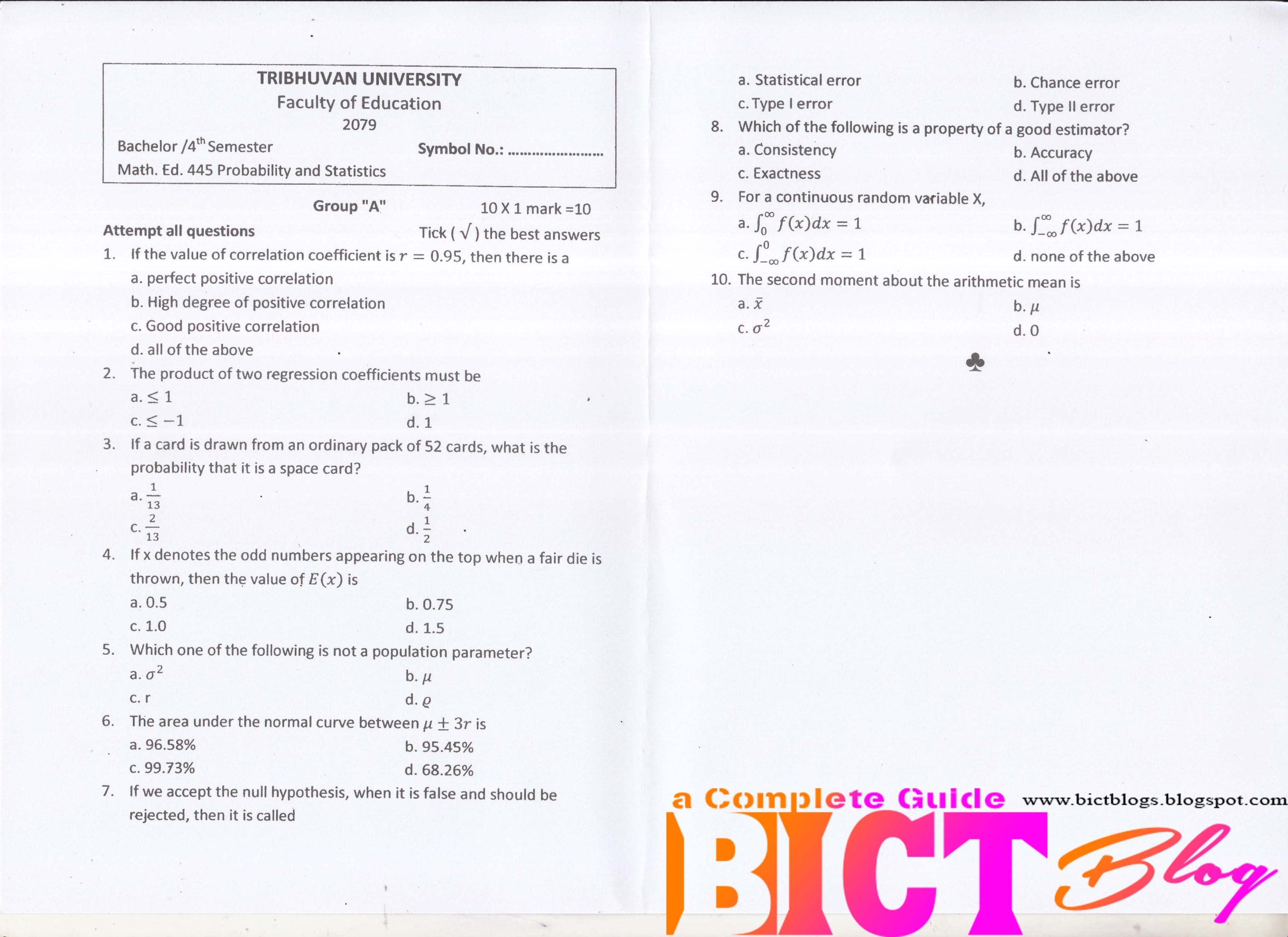
Students can explore TU BICTE Probability and Statistics old questions spanning board exams from 2075 BS through 2080 BS. It reflects both the revised 3rd Semester curriculum under course code Math.Ed.436 and the earlier 4th Semester syllabus under course code Math.Ed.445, giving students a complete view of university testing standards.
Whether you are preparing for an upcoming semester exam or revising backlog subjects, these past questions help you understand how university examiners balance theoretical definitions, numerical derivations, and applied statistical problems.
BICTE Probability and Statistics Question Papers 2075–2080 BS


What the Probability and Statistics Papers Cover
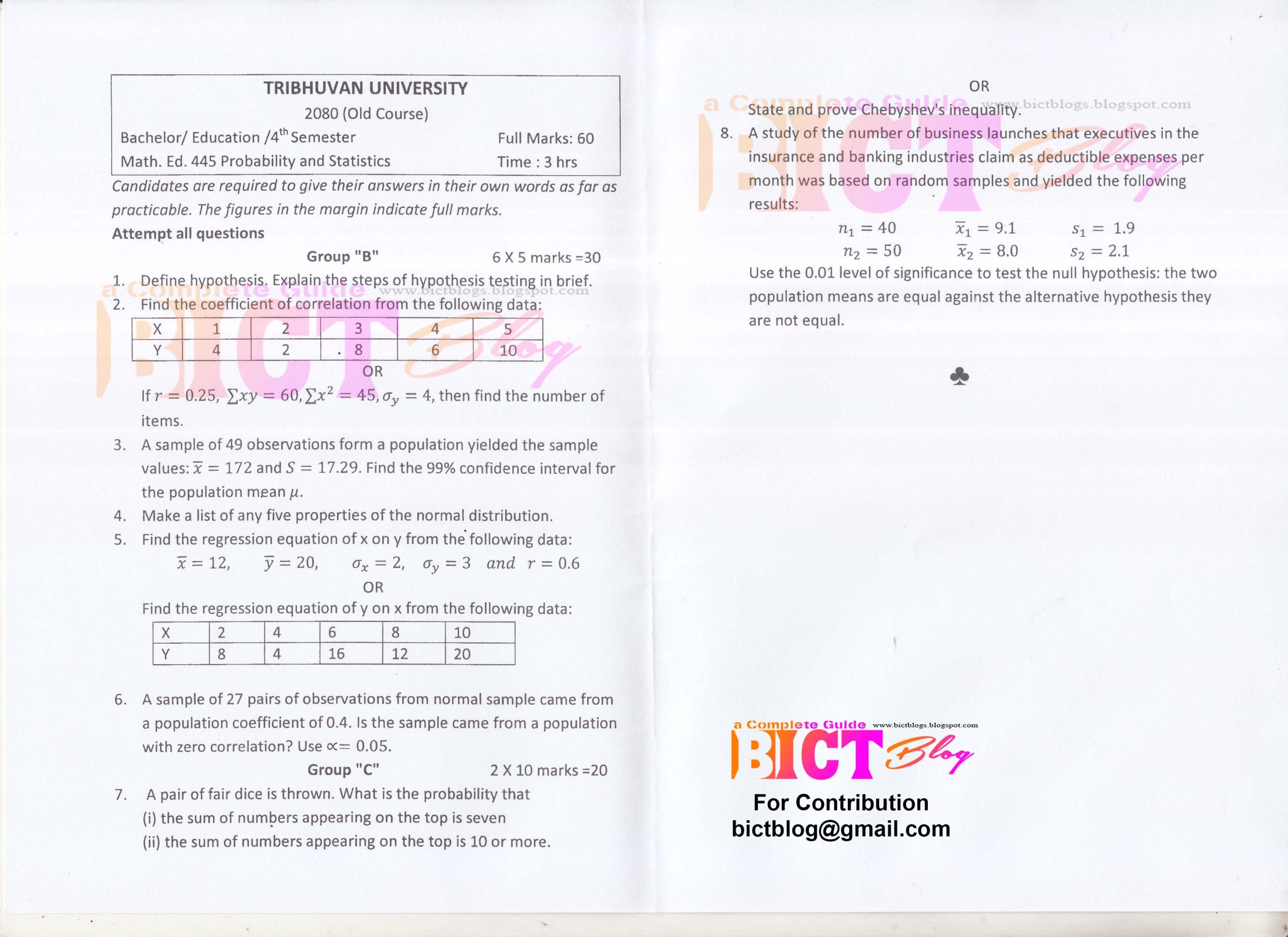
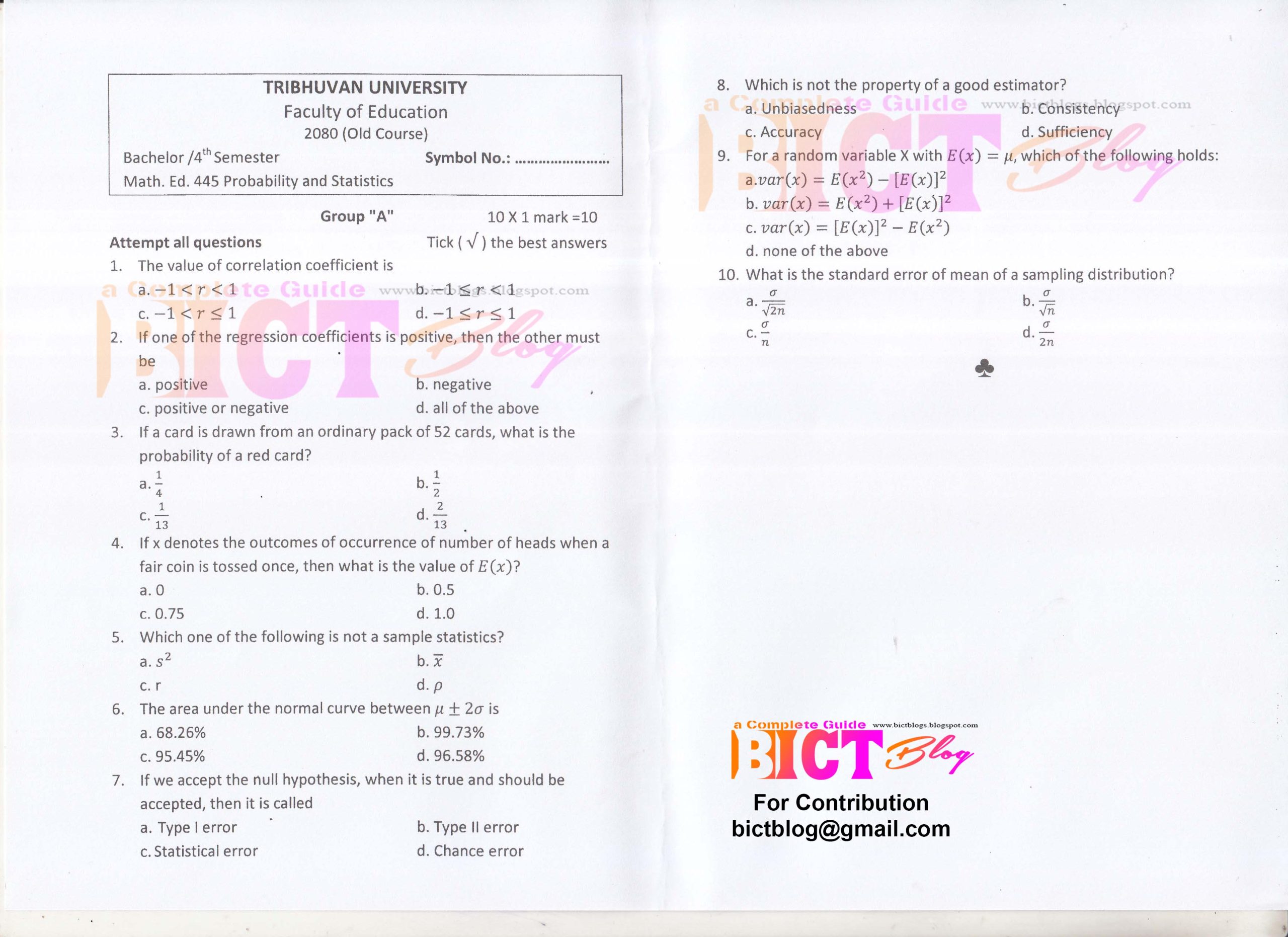
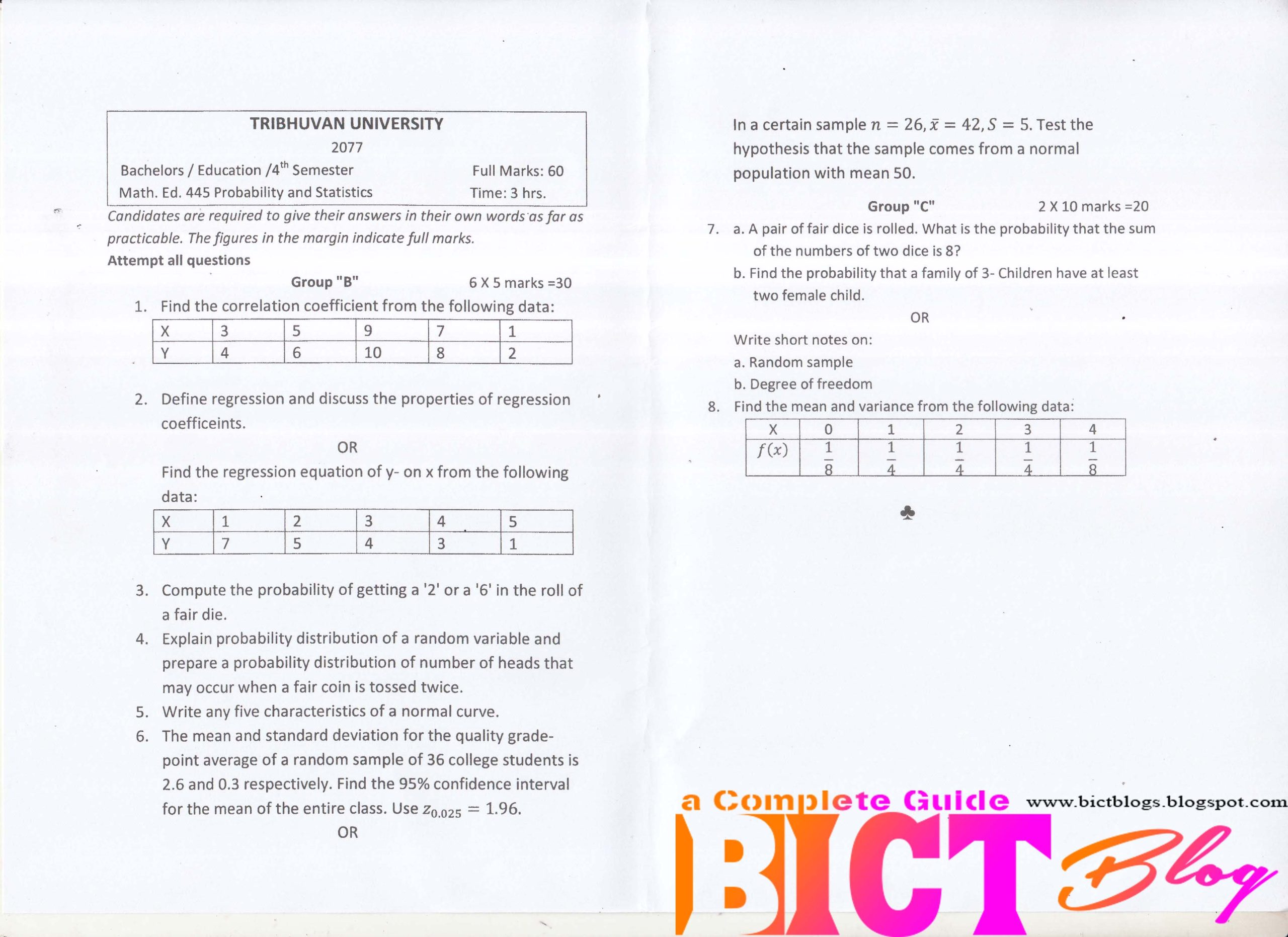
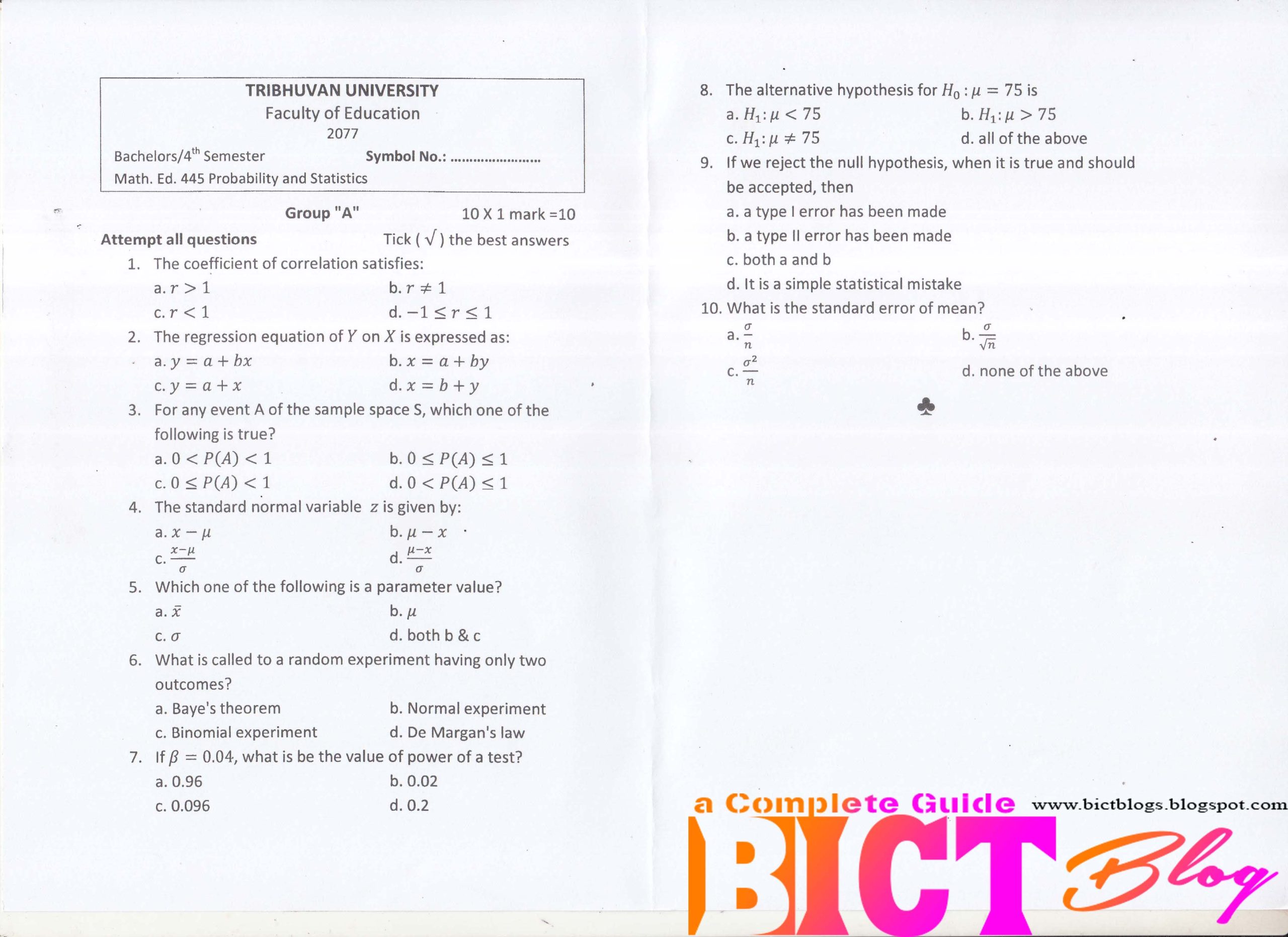
The Probability and Statistics syllabus for BICTE bridges mathematical reasoning with data analysis, establishing principles vital for computer science and educational technology. Past board examinations evaluate core probability concepts, from basic sample spaces and mutually exclusive events to conditional probability and probability distributions of discrete and continuous random variables.
Bivariate data analysis represents a recurring focus across past papers. Students are regularly tested on Karl Pearson’s correlation coefficient, regression lines, and the interpretation of regression coefficients. Questions require candidates to compute regression equations of Y on X or X on Y, analyze data pairs, and clearly distinguish between correlation and regression.
Inferential statistics forms another major testing area in the board examinations. The papers frequently cover properties of the normal distribution, standard errors of sampling distributions, point and interval estimation, and confidence intervals for population means. Hypothesis testing questions routinely ask students to state null and alternative hypotheses, identify Type I and Type II errors, and execute difference of means or goodness-of-fit tests.
Examiners also assess theoretical depth through analytical properties and proofs. Key topics include variance and expectation properties, criteria for good estimators, and classic results such as Chebyshev’s inequality. Reviewing these recurring themes helps students balance practical calculation with sound mathematical explanations.
Exam Preparation Tips for Probability and Statistics
Practice bivariate calculations by hand rather than relying solely on calculators. Computing correlation coefficients and regression lines involves extensive summation of products and squares. Working through full numerical tables manually builds calculation speed and eliminates sign mistakes during time-pressured exam conditions.
Solidify your understanding of probability rules and normal distribution characteristics early. Be ready to construct clear sample spaces for multi-stage experiments, and memorize standard normal curve properties including inflection points and area intervals. Sketching curves to mark rejection regions and confidence intervals prevents errors when interpreting critical values.
Structure your hypothesis testing answers systematically. Always write down the null hypothesis and alternative hypothesis clearly, specify whether the test is one-tailed or two-tailed, state the test statistic formula, and compare calculated values with table critical values before stating your conclusion. Clear step-by-step presentation earns full marks from evaluators.
Dedicate adequate revision time to theoretical definitions and short proofs. Concepts such as characteristics of good estimators, degrees of freedom, and Chebyshev’s inequality frequently appear in descriptive sections. Balancing computational practice with conceptual clarity prepares you for both objective and long-answer questions.
Frequently asked questions
Is Probability and Statistics in BICTE 3rd Semester or 4th Semester?
Under the revised Tribhuvan University BICTE syllabus, Probability and Statistics is taught in the 3rd Semester under course code Math.Ed.436. In the older curriculum, it was offered in the 4th Semester under course code Math.Ed.445. Past papers from both semesters cover essentially the same mathematical foundations and are equally valuable for exam preparation.
What is the examination pattern for this subject?
The external board exam carries 60 marks with a time limit of 3 hours. The question paper generally includes objective multiple-choice questions in Group A, analytical short-answer problems in Group B, and comprehensive long-answer questions in Group C covering theoretical derivations and applied hypothesis testing.
Which topics appear most frequently in past papers?
Frequently tested topics include Karl Pearson’s correlation coefficient, linear regression equations, normal curve characteristics, confidence intervals, sample variance, and hypothesis tests involving small or large samples and goodness of fit.
How do past question papers help in exam preparation?
Working through past papers familiarizes you with university question formatting, trains you to complete lengthy bivariate calculations within time limits, and highlights key theoretical proofs that appear across successive exam years.
About Noted Insights
Noted Insights was founded by Ajay Mahato in 2022 to provide university students across Nepal with reliable study materials, lecture notes, syllabus guides, and past question papers. Driven by the belief that education transforms lives, the platform strives to make quality learning resources freely accessible to every student regardless of their location.
Through its mission to empower learners with essential academic and technical skills, Noted Insights fosters a supportive community where students can connect with mentors, explore new ideas, and achieve their career goals. Approach your statistics revision with confidence, practice each problem carefully, and excel in your board examinations.


